Author Archives: Matt Jones

Fury Road: 10 years later

Mechanics share tales from one of the greatest action movies of all time.

(Originally printed in Service Truck Magazine, Oct/Nov 2025)
It was a decade ago (2015)—after 30 years of dormancy—that the Mad Max film series came screaming back into theaters. Mad Max: Fury Road starred Tom Hardy as series’ protagonist, post-apocalyptic ‘road warrior’ Max Rockatansky, along with actors Charlize Theron and Nicholas Hoult. It was the highest-grossing film in the series ($380.4 million worldwide), was nominated for 10 Academy Awards, and has been lauded as one of the greatest action films of all time.


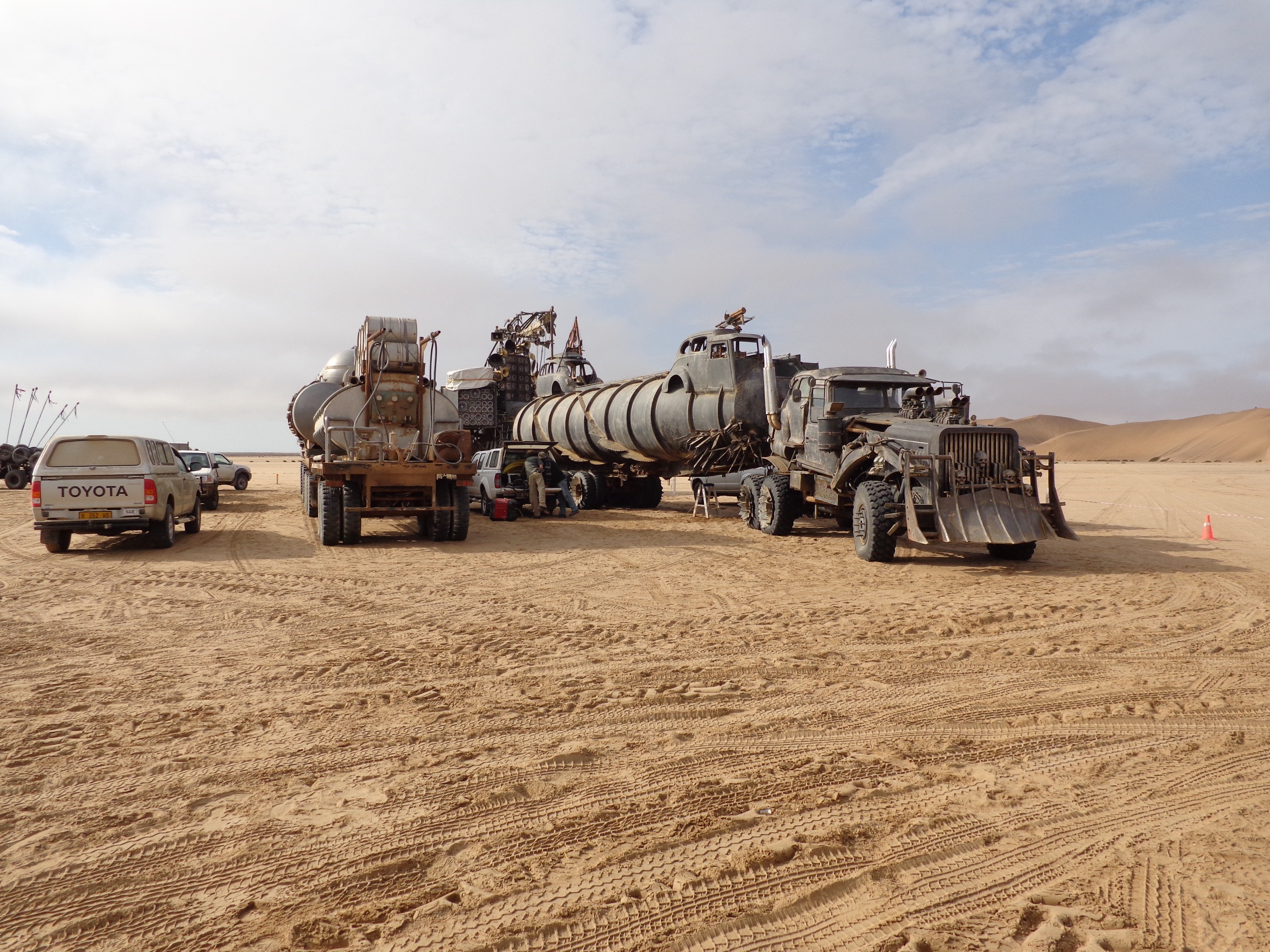
And besides the breathless pace and shockingly good storytelling and character development for a film with so little dialogue, Director George Miller continued his series-long love letter to automotive mayhem. Fury Road featured extensive scenes with fanciful and massive vehicles in a deadly chase across the desert wasteland. With Miller interested in doing as many things as possible for real on camera, this meant that the massive vehicles like the iconic War Rig, the Doof Wagon, and a whole fleet of others were constructed and actually filmed traversing and crashing around during a lengthy shoot in the Namibian desert in Southern Africa.

Readers of Service Truck Magazine are no doubt familiar with the challenges in keeping large-scale equipment serviced and running under relatively good conditions. But keeping such vehicles in operation in a windswept desert was an entirely different matter and required a platoon of mechanics and mechanic trucks. To find out more, STM spoke with two of the mechanics and fabricators who worked on Fury Road— Scott Cole and Mark McKinley.

To keep you, the reader, amused every one of the subheadings from here on out is a line taken from the movie as we found many parallels between the characters’ struggles in the post-apocalyptic wasteland and the mechanics’ struggles in the Namibian desert.


“Have You Done This Before?”
“Many Times”

The initial idea for Fury Road came to Miller a few years after the 1985 release of Mad Max: Beyond Thunderdome—to do a film in the series that was “almost a continuous chase.” Throughout the ‘90s, Miller further developed the story idea, and the film began pre-production in the early 2000s, with the intention of bringing back Mel Gibson, who had played Max in the first three films (Sigourney Weaver was said to be considered for the female lead role, which over time evolved into Theron’s role, Furiosa).

Meanwhile, between the conception and pre-production of the film, Mark McKinley’s long career in film had started by chance—he was an apprentice to an Australian mechanic who worked in fabrication and repair for film productions, who eventually double-booked himself. The mechanic asked McKinley to take over for him on one of the productions, which ended up being 1994’s Sirens. In the ensuing years, he would provide mechanic’s work for everything from The Adventures of Priscilla, Queen of the Desert to The Matrix Reloaded. He was contracted by Miller’s production company, Kennedy Miller Mitchell, for the initial pre-production for Fury Road and helped to develop many of the large vehicles.

“There was only a handful of us,” explained McKinley. “Anything to do with the mechanic side of it, I would be designing elements into the vehicles. Not so much the look. When we eventually did build the vehicles for Fury Road, there were some elements that I was picking that weren’t in the original designs. I’d get the designer, Colin Gibson, to come and have a look, and he’d say, ‘Yeah, that looks alright, we’ll go with that.’ If I thought of something that would work, I’d try it.”

McKinley said that occasionally, debate would emerge regarding the form and the function of the vehicles. While Miller or Colin Gibson (who would win an Academy Award for production design for the film) could be more interested in aesthetics, McKinley was focused on mechanical logistics. These types of creative discussions continued throughout the pre-production of both Fury Road and its 2024 prequel, Furiosa: A Mad Max Saga. For example, McKinley noted that there was one vehicle design that he, Gibson, and the other mechanics in the workshop were extremely excited about for Furiosa, but it was not what Miller wanted.

“It was a little bit disappointing that we never got to build our big mean vehicle,” said McKinley. “But I don’t want to make a big hoo-ha about that, because it’s all George Miller’s choices, you know?”

One hopes that the ‘big mean vehicle’ may resurface on HBO in an upcoming television series, rumored to be titled Mad Max: The Wasteland, but with McKinley’s recent retirement, he’ll have to wait to see it with the rest of us.

The initial production of Mad Max: Fury Road was indefinitely postponed due to a variety of factors, mostly relating to the fallout of the terrorist attacks of September 11, 2001, including the value of the US dollar against the Australian dollar and travel, shipping, and security concerns. A handful of vehicles already produced by McKinley et al would go into storage for the better part of a decade. After production was postponed, Miller briefly considered producing Fury Road as a Japanese-style anime film but, soon returned to his original vision, and preproduction began anew in 2009.

“Being Spared For Something Great”

Scott Cole joined the production in early 2010. Like McKinley, his entry into film was somewhat by happenstance. His brother-in-law, who worked in special effects, knew that the film was hiring mechanics and encouraged Cole to apply for the job. He has since gone on to work on everything from Pacific Rim 2 to the remake of I Know What You Did Last Summer. He was involved in the preproduction and design of several of the large vehicles, including the War Rig, the Doof Wagon, the People Eater’s Limo, and others. And while his task started with just trying to realize the producers’ vision, he was soon allowed to assert his own creative and mechanical influences.

Cole agreed with McKinley’s observation about conflicts between form and function. It would be one thing if George Miller were the type of director who would be happy using green screens, CGI, or other techniques to fake all the action in his movies. It would be easy enough to build a War Rig if all it had to do was sit in front of a green screen, and the movement and action were to be added in later.

“No, he wants every functioning aspect of it,” Cole mentioned. “So you can use that to detail, like redressing the two speed buttons on the gear shift so they’re leather-bound and stick rivets or something in them. They look beautiful, but there’s still a functioning object. It’s got to be functional and pretty at the same time. They thought it was just a pretty thing on the gear stick, but it was functional.”

Asked which vehicle that he helped work on that he’s most proud of, Cole doesn’t hesitate to say the War Rig—a nearly 80-foot-long 18-wheeler built around a Tatra T815, massively customized, including attaching the rear of a 1947 Chevrolet Fleetmaster to extend the vehicle’s cab. Three War Rigs were constructed for the shoot, and while the finished product carries the metaphorical thumbprints of a whole host of bodybuilders, steel manufacturers, welders, and others, Cole can directly see his influence on the final product.

“I built all the exhaust on that vehicle—the air cleaner, the way it’s mounted,” Cole explained as a-matter-of-factly. “The way it was mounted originally, when it got folded up, it just had sharp edges on it, but I went back and remade the same round loops that hold the air cleaner on one side of the truck and put little turn-ins on the side of it so no one could get caught.”

As part of the ‘lived-in’ aesthetic of the vehicles in the film, the crew responsible for ‘dressing’ the vehicles would include details like tools and equipment that characters could use to keep them running. Cole related that he would request that they use real tools for those purposes. Then, if he or another mechanic were working on one of the vehicles and needed something, they could just use one of the prop tools if it were handy.

“Out Here, Everything Hurts”

While some parts of the film were shot in Cape Town, South Africa, and a few locations around Australia, the bulk of the film was shot in the Dorob National Park in Namibia. McKinley was the head mechanic for the shoot, and Cole is credited as a truck mechanic. In total, the film employed 22 different mechanics (23 if you count actor Angus Sampson, who played the character The Organ Mechanic).

Cole stated there were three crews of mechanics and mechanic trucks: one focused on cars, one on motorcycles, and one on trucks and larger vehicles. As one would expect for a shoot in the desert, air cleaners were a priority item to stock on the truck-focused mechanic trucks, though spare oil filters were also in high demand.

“We’d carry brake boosters, we had to have a spare turbo, we had a spare intercooler, we had spare tires on rims, we had spare panels,” Cole said. “We didn’t carry the tires and the rims in that truck; they’d come on something else. But we’d have spare body panels for the War Rigs’ trailers. We’d carry spare doors if something got damaged. We’d have spare glass for any of the windows in there. You’d carry huge amounts of air fittings, oils, and coolant. It just went on and on. If you didn’t have it, you’d need it.”

In addition to the trucks being loaded for bear, the mechanics themselves had to be filled with knowledge. Between all the different large vehicles, the truck mechanic team had to know the ins and outs of working with Tatra, Cummins, and MAN, among other engine types.

If a problem were more extensive than the teams could handle in the field, there were also a few other options nearby. A large warehouse in Walvis Bay, Namibia, was turned into a ‘home base’ where damaged vehicles could be attended to. Cole also describes several shipping containers having been stacked with a domed roof on top to create a makeshift aircraft hangar, which served a similar purpose.

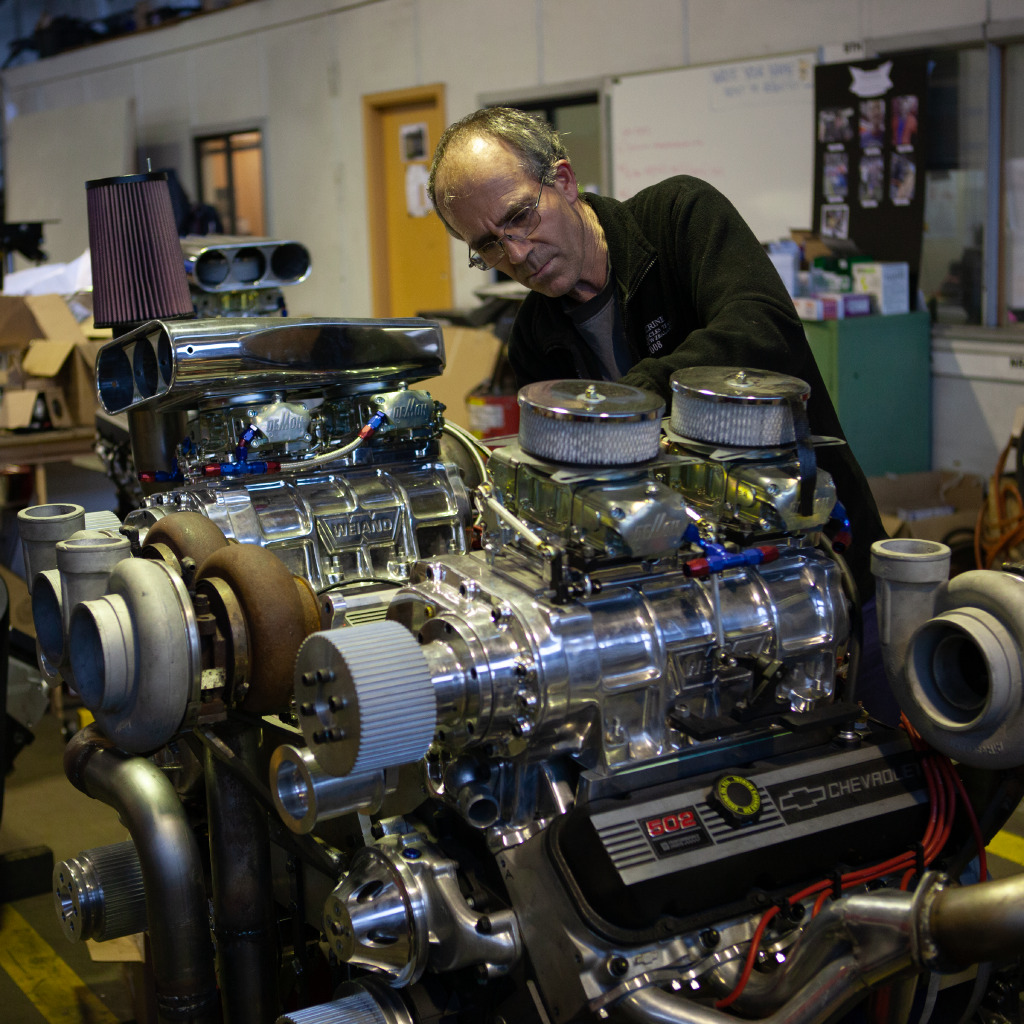
Below: Mark McKinley working on the engines of the Gigahorse vehicle, during the pre-production of Mad Max: Fury Road (photo courtesy John Platt).

“160 Days Ride That Way… There’s Nothing But Salt”

Mist was one of the biggest challenges the team faced. McKinley explained that every night there’s a salty sea mist that comes off the ocean—possibly very beautiful to look at, but incredibly corrosive to any exposed copper cables that were part of the vehicles.

“If it was exposed, they were just turned to green mush,” McKinley stated. “[A vehicle] would start one day, and then the next day you’d go to start it and you’d have nothing. It just wouldn’t start. You’d track down the main cables and say, ‘Oh, there it is; it’s all goo-ed up.’ So we had to replace some of the connections and things.”

Cole described standing in that fog in the pre-dawn hours as being the same as standing in rain. But while that may sound like copy from a tourism brochure, when that saline mist is causing massive issues with rust and corrosion, the potential beauty of the moment is severely undercut.

“Things like S Cam Anchor pins were rusting up,” said Cole. “The clevis actually seizes in the S Cam adjuster. You have to spray them every couple of days so that doesn’t happen again to you. You get under there, and you gotta whack him with a hammer and free him up, and then spray him again, and away you go again.”

McKinley said that the team would generally start their day getting the trucks warmed up and ready for the stunt drivers to pick them up. And, after dealing with whatever situations and emergencies arose during the day, they would make a point to perform service on the vehicles every night, largely driven by how air filters needed to be changed frequently.

“The fine dusty silt,” recalled Cole. “You can have a camera vehicle running in front of a truck as it’s running down the road, and it’s running through the sand, and it’s sucking up all that shit. You don’t see it so much, but you’re blocking the air filters. Within a week of running in the desert, you’re throwing away an air filter, and you’re throwing a new one in to maintain that everything’s good.”

“It was a hellishly dusty environment that they were all working in,” added McKinley. “So that was a mission, changing filters, going over for loose nuts and bolts and any oil leaks, and during the day we had a fuel truck going around keeping all the fuels topped up, which was good; something we as mechanics didn’t really have to look after.”

Cole said another common task they had to perform was bleeding air out of the systems. A large liquid-filled pneumatic ram system was used in the War Rig, but within a few weeks, they found that when left overnight, air would be sucked back into the system because the coolant is thinner than water.

“So first thing in the morning, you’d go and jump in the truck, fire it up, air it up, go to take off, and the gear stick would feel like a big wooden spoon stirring a bowl of porridge,” said Cole. “So then it was engine covers off, use the air from the truck to pressurize the coolant tank—which is just a reservoir for the gear shift, clutch, and brake—push it out, bleed it out, get the bubbles out of it, and release the pressure out of it. These things went on day after day, religiously.”

“If You Can’t Fix What’s Broken, You’ll Go Insane”

Complicating matters was that to access the engine systems of the War Rig required removing two separate heavy hatches. Cole explained that there were many times when, halfway through the day, while actors and set dressers and other crew might have been on lunch break, he or other mechanics would be working to ensure the War Rig was ready for the afternoon’s shooting.

Cole recalled one day when some Dynex (a heavy rope often used in stunt rigging) became ensnared in the brakes of one of the War Rigs. An assistant director asked how long repairs would take. Between all the disassembly, repair work, and reassembly, Cole estimated an hour and a half. The assistant director decided that they couldn’t wait that long, so he called in one of the other War Rig vehicles. However, the second War Rig needed to be ‘dressed’ so that it matched the part of the movie they were shooting.

“So they go and get the other truck, and they’re sitting beside each other,” said Cole. “They start dressing it, and by the time they’re finished dressing it, I’ve got the wheel off, the drum off, the Dynex off and fixed back together, and I go, ‘You could have taken this one.’”

Another situation that stood out to him was during pre-production in Broken Hill, Australia, where a stunt test was conducted with one of the War Rig vehicles. They were practicing for a scene where a vehicle explodes in front of the War Rig when the engines on the big truck cut out entirely.

“What had happened is that the unit was engulfed in flame, and it burnt through the intake, burnt the air cleaner, and as that was burning, it goes down into the turbo,” recalled Cole. “So we did the turbo and air cleaner in one hit. So that’s a lesson learned. ‘Let’s not do that again,’ so that never happened again.”

Asked if any specific incidents stood out to him, McKinley demurred, “No, it’s all a bit of a blur.”

“Where Must We Go… We Who Wander This Wasteland In Search Of Our Better Selves?”

Both Cole and McKinley would go on to work on the follow-up, Furiosa: A Mad Max Saga. And both said that they found it incredibly rewarding that they were able to use their experience from the previous film to exert influence over the sequel. Both identified the remote driving rigs—sometimes called ‘pods,’ where a stunt driver will control a vehicle from an external attachment so an actor can be filmed naturally behind the steering wheel—as an area for improvement.

“When Furiosa came along, I had a bit of a word with the special effects people,” said McKinley. “I said, ‘Look, we can’t have it like we had it in Fury Road; it was really problematic.’ There are other ways of doing it, like just extending systems rather than implementing another system to make these remote driving rigs work. Just extending systems was far better, and we didn’t have anywhere near the problems.”

Cole was asked by Colin Gibson for input, so he suggested doing away with manual gearboxes.

“It’s hard when you put a drive pod on the side of them,” said Cole. “It was all easier to do wiring than to do silly gear changes. Now that I’m older, I get more input… In your first movie, you can’t tell people that they’re stupid or ‘you’ve got to keep it simple.’ But now, 15 years later, I tell people that it’s got to be KISS—Keep It Simple, Stupid.”

Now retired, McKinley reflected on his career in film with obvious pride. However, when asked which job he worked on was the most impressive in terms of scale or logistics, he actually cited his work on the opening ceremonies for a variety of sporting events, including the 2000 Olympics in Sydney, Australia, the 2015 European Games in Baku, Azerbaijan, and, in particular, the
2006 Asian Games in Doha, Qatar.

“That was fabrication and a lot of design work as well,” recalled McKinley. “The pinnacle of my career was probably the Asian Games in Doha because it was quite a technical show, and I was the head mech for everything out of the field of play.”

Cole has typically bounced between his work in film and more traditional mechanic’s work, but in the past five years, most of his work has been in film. To hear him speak, it is readily evident that he finds the work highly rewarding.

“It’s great,” summed up Cole to Service Truck Magazine. “You’ll get to the end of a movie and you go, ‘I’m over this, I’m not going to do this anymore,’ and within three weeks you want to know when the next one is.”

Tagged , , , , , ,

Cranes On Film

Originally printed in Crane & Hoist Canada in September 2019

Cranes play a crucial role in many movie and television productions by assisting with camera shots and the construction of sets and other functions.

But cranes have taken a starring role in some productions as well, either as the driving force behind a frenetic chase scene or playing a functional role in a reality television series. Key players in the companies involved spoke with Crane & Hoist Canada about what was involved in those moments.

The champion of movie crane scenes

Over 40 years of operating in California, Champion Cranes president Mike Konle, has provided cranes for a bevy of movie, television and advertising scenes. Being located near Universal Studios, Warner Bros. and Sony put his business in an ideal location to provide cranes for everything from elaborate pranks on Johnny Carson’s Tonight Show to helping stars like Tom Cruise and Angelina Jolie make daring leaps from buildings.

One film stands out in particular, however, since the crane itself took centre stage. In Terminator 3: Rise of the Machines, the villainous T-X, portrayed by Kristanna Loken, hijacks a massive Terex-Demag AC 160-2 mobile crane emblazoned with the Champion Cranes name and cuts a swath of destruction through Los Angeles in pursuit of Nick Stahl’s John Connor. The chase sees the crane smash through cars and buildings, including a sequence with Arnold Schwarzenegger’s T-800 dangling from the loose boom, before being dramatically flipped over when the hook snags on a manhole cover.

Konle says that he was approached about the scene by the film’s special effects team, which was looking to do a chase scene with a vehicle larger than a fire truck. The crew fell in love with the size of the AC 160-2 and decided to use that as the basis for a model; which they would shoot to capture the chase scene. However, Konle offered them the opportunity to make the scene much more real.

“I said, ‘How would you like to have a real crane to bash and crash instead of a model?’ We sold it to the Terminator crew and we bashed it and crashed it for three months. We rolled it over, we ripped the outriggers out of it, drove it on five wheels, drove it through walls and hit police cars. It was a spectacular scene for sure.”

While almost everything in many big-budget blockbusters is CGI these days, Konle says that only part of the scene is computer-generated – the hook dropping into the manhole cover and the crane flipping over afterwards. Other than that, everything was done with practical special effects and actually smashing the crane into cars and telephone poles and everything else. The building that the boom smashes through (see photo) was constructed specifically for the film.

“It wasn’t as tough as a real building or we would never have been able to do what we did to it,” says Konle. “But all the crashing into the cop cars, and that, was all real.”

Originally the crane was going to be altered by rebuilding all the controls on the passenger side for the stunt driver, so Loken could appear to be in the driver’s seat. After Konle informed the production team that this would cost in the range of $250,000, the only alterations to the crane ended up being a roll cage and five-point harness for the stunt driver and a fake steering wheel for Loken on the “wrong side.”

“She’s driving from the wrong side of the crane,” says Konle. “But to this day, I don’t know anybody that has noticed that I didn’t tell.”

After the shoot was completed, the crane was repaired and sold to a company in the Midwest. Konle says that it is still in use to this day.

Irving Equipment and The Curse of Oak Island

Oak Island in Nova Scotia has been a source of mystery for many years, with theories of what may be hidden on the island ranging from Shakespearean manuscripts to the Ark of the Covenant. In 2014, a History network reality TV program, The Curse of Oak Island, began exploring the island and Irving Equipment have been providing support ever since.

“We’re involved in a couple of different ways,” says general manager David Irving. “Right now we’re there to assist the crew on site in their exploration efforts. Very different from the traditional projects we do where there’s a schedule and it’s all about productivity. We’re trying to accommodate them where we can – if they want to stop and dig and explore an artifact, we’re here to support them and get them access to the areas of the ground that they’re looking for.”

For a couple of early seasons of the program, the work was focused around the area known as the “Money Pit.” There, they drilled large diameter caissons and excavated so the show’s stars could sift through the contents. There, Irving Equipment utilized a couple of hundred-ton crawler cranes, including a Link-Belt.

In seasons five and six, more work was focused around the Smith’s Cove area, where a 300-ton Manitowoc 2250 crawler crane was used to drive a coffer dam into the ground. Back at the Money Pit, since a larger diameter oscillator was being used, a Liebherr HS 895 was utilized.

Irving says that while the actual operations being performed are typical for Irving Equipment’s work, it does take some adjustment for the crew.

“It’s a little bit out of the norm for our guys, you have to develop a comfort level with it,” Irving says. “There’s cameras and mics on everybody, our guys aren’t used to being in the spotlight like that. I think that’s a bit of an adjustment.”

The one technical challenge Irving identifies is simply trying to determine the right places to drill for excavations. Working alongside a seismic company the production contracted, Irving offer opinions on soil conditions and what the most effective equipment would be.

“We’ve been fortunate to develop a good relationship with the production team and that they’ve called on us now a few times,” Irving says. “I don’t know if we’ll make a habit of this, but if they’re in the neighbourhood we’re happy to offer any support that we can.”

Famous (and infamous) crane scenes in movies

The action packed crane chase in Terminator 3 was one of the most spectacular crane scenes in movies, but there have been many others over the years. Some are iconic and visually stunning. Others raise reams of logistic questions and may seem completely ridiculous.

Terminator 2: Judgement Day – Likely the most famous crane related scene in a film, though certainly more understated than many others on this list. After defeating the T-1000 by dropping it into a vat of molten metal, Arnold Schwarzenegger’s T-800 insists that he must be lowered into the same vat to prevent his parts from being salvaged, thus averting the future robot apocalypse. After a tearful good bye, the T-800 is lowered into the molten metal by way of an overhead crane.

The Adventures of Tin Tin – The mystery at the heart of this animated feature by Stephen Spielberg centres around a 17th century high-seas skirmish between Sir Francis Haddock and the dreaded pirate Red Rackham. In the film’s climax, their descendants, Captain Haddock and Sakharine, relive that battle in bombastic fashion, by engaging in a sword fight using the jibs of two massive dockside tower cranes.

The Amazing Spider-Man – When it appears that Andrew Garfield’s Spider-Man may be too injured to race to the climax and the villainous Lizard, a crane operator whose son Spidey saved earlier in the film comes to the rescue. In a stroke of luck (or perhaps plot convenience) he and his co-workers know every crane operator in New York, and they all position their cranes in such a way that Spider-Man can use them to quickly swing to the final battle.

The A-Team – This adaptation of the classic television series features many complex (even convoluted) plans, but the film’s climax may top them all. In order to outwit a crooked federal agent, the team performs a version of the classic cup-and-ball con game. However, they do so with two massive dockside tower cranes and a bevy of shipping container trailers. The crane movements utilized seem beyond the realm of possibility, particularly since there had been little indication that Bradley Cooper’s Face had any experience as a crane operator.

Skyscraper – In this action film, Dwayne “The Rock” Johnson’s Will Sawyer uses a massive tower crane to gain access to the titular skyscraper. Of note, he rocks (no pun intended) the crane’s trolley back and forth to build up momentum so that the hook will fly out and smash an opening in the building. Like the A-Team, the crane manoeuvres seem suspect, particularly since again, there is no indication that Sawyer, a former marine and hostage negotiator, has any experience in crane operation.

Casino Royale – Daniel Craig’s first outing as James Bond features a thrilling parkour-styled chase scene around a construction site, which involves much climbing and jumping from a mobile crane and two tower cranes. Most of the action is fairly credible, likely helped by the fact that Bond’s target, bomb-maker Mollaka, is portrayed by parkour legend Sébastien Foucan. The one moment that raises questions from a crane perspective, however, is when Bond climbs onto the load of pipes being carried by a crane and hits a quick release lever that drops the load and causes the hook to retract. Such a mechanism seems like it would surely violate many workplace safety protocols.

Service truck industry weathers spare parts shortage

Originally printed in Service Truck Magazine Sept. 2022

Any person working in the automotive service industry is intimately aware of the ongoing spare parts shortage at this point. Stories of vehicles being stuck in garages for weeks waiting for parts are now common as the $300 billion auto-parts and repair industry faces a growing crisis. A garage owner from Philadelphia told Bloomberg news that they refer to it as the ‘intergalactic backorder’ as though they were waiting for parts to arrive from another galaxy. And in addition to the delays, prices have also risen significantly during the same time period.
But what caused this shortage? And what have the impacts been on service and mechanic truck operators? And what can be done to return to some degree of normalcy? Service Truck Magazine spoke with a variety of industry professionals to find out.
ALL ROADS LEAD TO COVID
John Firm, mechanic operations division chair for the Automotive Service Association (ASA), says there is one root cause to all these problems – the COVID-19 pandemic. The pandemic has had an impact on almost every aspect of our lives and it has similarly impacted every step of the supply chain, from material sourcing to manufacturing to importing and exporting.
“When you have a manufacturing facility that’s building a product and it takes 25 people to build that
product from beginning to end and then you have 20 of those people go out with COVID, you have five
people in that assembly line, trying to build that product,” says Firm. “You burn those five people out
pretty quick. Then you can’t build the product.”
Such COVID-exacerbated labour shortages have been the significant driver of these issues. Last year, all the major tire manufacturers announced price increases in quick succession after rubber production stalled when tappers from Laos and Myanmar were unable to travel to Thai rubber plantations due to the COVID-19 lockdown. Whether stemming from travel restrictions or workplace absences due to sickness, the pandemic has sent shockwaves through the manufacturing sector, which then trickles down into businesses that rely on spare parts.
“A really close friend of mine is a major manufacturer of oil filters, building them for five different
brands,” says Firm. “To run a line of filters takes 15 people. When you have 10 of those people out with
COVID, you’ve got to pull five people from another line and shut that line down. You’re shutting other assembly lines down in order to make one that works. And there’s your backlog, that’s why we’re not
getting parts and inventories.”
The steps in that supply chain are also more costly now as well. Firm says that prior to COVID-19, it would cost roughly $5,000 to have a container put on a ship, brought to North America and shipped out via transport truck. Today that same process would cost roughly $20,000.
“Now you’ve got the guys who can’t afford to pay the 20 grand, or you’ve got the guys that can afford to pay it and now the price of your products will skyrocket,” says Firm. “And that’s another thing we’re seeing – $20 items we used to buy are now $40 items.”
Firm also notes many manufacturers are attempting to build their own reserves in order to protect against further shortages. If a box of 20 items used to be standard, they may now only ship 15 and keep 5 in reserve.

John Firm, who had been a representative of the Automotive Service Association at the time of this article’s original publication.

WHAT HAS BEEN AFFECTED
Computer chips are commonly cited as being harder to source and more expensive to obtain. Firm says there are plans for a computer chip factory in Detroit, Michigan, but the facility is not yet complete. “Manufacturers were paying $3 per chip before COVID-19,” says Firm. “When the manufacturers quit building cars, the guy building those chips has to find somebody to buy them. So what went hot? TVs, computers, anything with entertainment. And they realized they could sell their chips for $12 and $20 for computers and TVs.”
Marc Karon, president of Total Truck Parts, Inc. and a member of the board of directors of the Commercial Vehicle Solutions Network, says that his company has experienced challenges in sourcing sensors and other electrical parts. He also noted that he expects Freon to become scarcer, though he attributes that to environmental activism.
“Another area where we are seeing critical shortages is in the area of engine parts,” says Karon. “We repair engines in our shops and we sometimes have to hold up a job waiting for a critical component. We have also seen shortages of media which affects filters. High quality steel affects bearings. And the one area that affects all of them is labor shortages. Many suppliers tell me that they have the subcomponents of the parts we need but they cannot get enough people to staff assembly lines.”
Nate McMurtrey, owner and operator of Offroad Wrench, says that the parts shortage cost him an
engine in one of his service trucks this year. His 855 Cummins needed injector sleeves and valves
replaced but neither of his local machine shops had access to the parts. He was eventually able to
source injector sleeves but not valves and ended up giving up and swapping out the entire engine.
“It devastated the start of 2022 for me,” says McMurtrey. “They told me I’d be looking at two to three weeks wait, so we made the decision to swap an engine out and we ended up having some other parts availability issues as we were doing the engine swap. So the total downtime was closer to five weeks of lost billable hours, and that’s just on my truck, that’s not even the customer stuff.” McMurtrey also had issues with a logging yarder. He needed cylinders for the guideline drums and it took two and a half months to get replacements. He’s also experienced a variety of other parts being unavailable with no set date for when they’ll show up.

“There’s obviously the used parts route that we could go with but the customers and the fleets that I
operate with prefer not to use used parts,” says McMurtrey. “They prefer preventative maintenance
ahead of time. And I operate my own stuff the same way. But I still ended up putting a used engine in.”
McMurtrey notes that part availabilities in some cases have begun to improve, however the high
demand has also led to price increases.
“The stuff that is available is astronomically expensive at this point,” says McMurtrey. “And the stuff
that’s not available, we don’t know when it will be available.”

INDUSTRY RESPONSES

Like many automotive and machine service operators, McMurtrey has responded to the shortages by stockpiling parts in hopes of being prepared for when a need arises. He operates with 3 fleets on a regular or semi-regular basis, so fleet management is key to his business. He’s currently looking for used engines that can be rebuilt and stored for when they’re ready to use.
“We are collecting major components for the equipment and looking at what the value of having that component in our stock is,” says McMurtrey. “Because relying on parts availability, just calling your dealer and your parts houses has gone away.”
One of McMurtrey’s clients has three or four machines with identical undercarriages in use and they’ve purchased an entire track rail assembly, rollers, idlers and sprockets, which are all waiting on the ground in the case of any failures that need to be dealt with. Another fleet he works with placed orders for two brand new undercarriages with the OEM at the end of 2021 and they have not yet arrived.
“We’ve also had some aftermarket undercarriages and those companies have gone bankrupt and left us with undercarriage we can’t service,” says McMurtrey. “So last year we made the decision to stay with our local dealers and purchase OEM undercarriage for these fleets. That way we have local support, local pressure and buying power.”
In addition to engaging with this topic at a high level with the ASA, Firm has also felt the impacts firsthand as the owner of Firm Automotive. He says that when a vehicle comes into his shop with a component failure, they often have to let the customer know that the part is on backorder with no estimated time of arrival (ETA).
“Or, we have to let them know that you can’t believe the ETA,” says Firm. “A lot of parts that we get from the manufacturer say they’re going to build it, and they’re going to deliver it in a week from now or two weeks from now. But when that date comes around they’ve issued another date. We’ve seen that a bunch of times.”
Not all businesses struggled due to the parts shortage, however, as some were able to position themselves to take advantage. Karon says that Total Truck Parts benefitted significantly, as they had anticipated there would be supply interruptions after the initial COVID-19 lockdowns and that they would cause price increases.
“We did a lot of advanced purchasing and buying in extended quantities,” says Karon. “When the price increases came, we were able to sell our extra inventory at the new prices which resulted in significant profit gains. Although there have been some improvements in the supply chain delays, we are still seeing shortages of key parts and we are stockpiling these. In some cases, we are stocking more than a year’s supply.”
Karon also says that parts shortages have made his company more creative in how they service their customers. When a truck is down that typically generates thousands of dollars a day in revenue because of a $50 part, customers are less concerned about the cost of the part than when they will get it.

“As a result, we do a lot of sourcing away from our major supplier when they cannot meet our needs,”
says Karon. “This has been taxing on our sales team, but they are very effective and work hard to take
care of the customer. Unfortunately, suppliers have not stepped up and set up too many rules to make
emergency sourcing difficult. The result is they lose business.”
Another trend he has seen is suppliers increasing their freight minimums, which has caused Total Truck Parts to move to other suppliers. While Karon sympathizes with the suppliers having to bear the increased costs of freight, he notes a better approach would be to limit the number of orders per week.

“Increasing freight minimums do no lower costs,” says Karon. “All it does is drive business away. How does that make a company more money? We have successfully negotiated shipping programs with many of our suppliers and they are enjoying significant growth in our purchases.”
Karon feels that companies with the ability (read: capital) to do so, should be planning ahead and stocking parts that may be in short supply in the future. With Total Truck Parts being based in Florida, they are aware of the possibility of disruptions stemming from hurricanes, so they have detailed mitigation plans. The parts shortage is another, equally predictable circumstance in his view.
“We pay attention to what is going on that might affect availability,” says Karon. “The environmental movement is pushing to shut down R134 Freon availability. Thus, we stock up just in case. When we see steel prices increasing like they did last summer, we purchased drums. At one point, we had a year’s supply in stock. Now the availability is better, so we have let the stocks run down some. Manufacturers use ‘just in time’ inventory which will not allow for any interruptions in supply. We think that is the wrong approach. When commodity prices are rising faster than the cost of capital, buying inventory is a great place to park your cash.”

HOW TO MOVE FORWARD

Understanding how these shortages developed and the impacts that they have had are only useful as a means of determining how to move forward. Returning to ‘normal’ may be impossible, but we may be able to achieve a new ‘normal.’ Given the logistic complexities that have been impacted by the COVID- 19 pandemic, Firm’s biggest suggestion is to simplify supply chains by bringing manufacturing back to domestic soil and reducing outsourcing and importing.
“I think by bringing back manufacturing here, it will open up more jobs as far as the trucking industry and delivery,” says Firm. “If we brought manufacturing back to the North American continent, we could be stronger, and we could be outsourcing the stuff to those countries. They’d like American products a whole lot better than what we like from China.”
However, that is not nearly as easily done as it is said. Manufacturers have traditionally enjoyed outsourcing overseas for cheaper labour costs. And furthermore, truly learning to live with COVID-19 is not just a matter of dealing with having more people out sick, but making infrastructure investments to mitigate impacts, such as outfitting facilities with high end ventilation systems. These are significant investments that manufacturers would have to grapple with. Are they willing?
“There’s gonna to be some changes to get there,” acknowledges Firm. “The minimum wage, they’re increasing that, that’s going to help as far as manufacturing, now people can make a living doing that. But we still have to sell that product at an increased price. And we have to get North America to bite on a better quality product for a little bit more money. And we have to deliver that better quality product. There’s a well known saying right now, ‘don’t buy anything that was made during COVID that’s an RV.’ Because they put them together with half the staff and they have a lot of problems. We’ve got to say, no matter what it is, we still do the best we can do and deliver a top quality product. We don’t have to rely on an imported product.”
Representatives of the National Association of Manufacturers did not respond to requests for comment on this topic, however, a spokesperson for their Canadian counterparts, the Canadian Manufacturers & Exporters, offered the following comment.
“The shortage comes from manufacturers’ inability to source these parts from abroad because of the fracture of long, complex supply chains, and a lack of domestic alternatives. This in turn leads to our calls for two big things: 1. Government needs to properly scope out and map Canada’s industrial capacity, and 2. Once that is done, we can target vulnerable areas in the supply chains, but overall help manufacturers invest in growing their businesses.”
Karon suggests another approach to increase productivity in the workforce would be to lower the age requirement for obtaining a commercial driver’s license (CDL) to 18 and to make them easier to obtain. “We just had to pay $2800 to get one of our employees a CDL,” he says. “How many 18-year old’s have $2800?”
He would also like to see the reinstatement of investment tax credits that existed in the 1970s, programs like Work for Welfare, a review of regulations that discourage investing in US-based manufacturing as opposed to southeast Asia and creating a $2000 a year tax credit for 18-20 year old’s who go to work in a brick and mortar business or factory.
McMurtrey says that he would like to see more unity on behalf of the industry at large to put pressure on manufacturers. He describes himself as an OEM advocate, which perhaps makes him an oddity in the independent service world. But through his preference for OEMs, he believes he has some pressure he can place on dealers to get things accomplished.
“Buying power comes from unity and if all we’re doing is searching for the cheapest price anywhere, you don’t get any kind of power, your buying power diminishes,” says McMurtrey. “If you’re the guy that is always just searching for the best price, you’re going to get left in the weeds. If you are building relationships within the industry and strengthening those relations, by combining your buying power you’re going to do much better.”
He adds that young independent operators getting into the industry need to ensure that while they are building their relationships with their customers they should also be building their relationships with the vendors.

“In the next couple of years, that’s going to keep an outfit with work in front of them,” says McMurtrey. “I do my best to save my customers money by building relationship and limiting the number of vendors we have. We’re going back to trying to get as many things as possible from one vendor instead of just price shopping because it takes so much time. We’re willing to pay a little bit of extra money to have somebody else actually do all that searching for us. It’s not all about just making money for yourself – it’s about keeping the end user, your customer, up and running. And if you stay focused on that, and build the relationships, the money comes after that.”

Quebec crane operators march on Premier’s office

Originally printed in Crane & Hoist Canada June 2018

Union members concerned over new training regulations

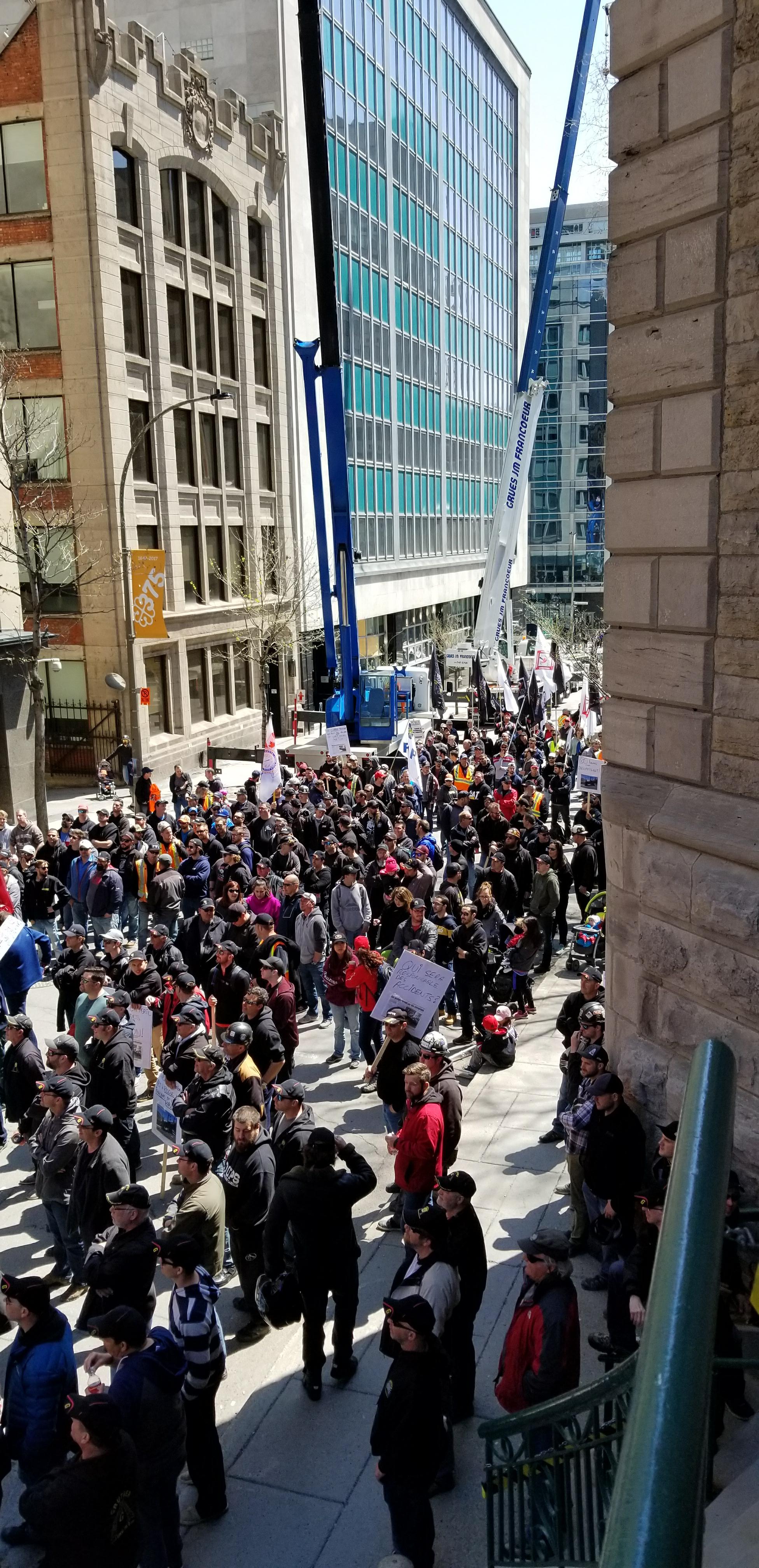
In early May, members of Quebec’s crane operators union drove their rigs through the streets of Montreal en route to a protest on the steps of the Premier’s office voicing their opposition to recent changes to training regulations. The new regulations make it easier for journeypersons from other trades to enter the crane field, and allow in-house training to be utilized. The changes have been enacted in anticipation of an upcoming labour shortage.

gillesexec.jpg

Gilles Larivière, Local 905

Spokesperson for the Local 905, Gilles Larivière, says that the union are concerned that these changes will cause safety issues.

“It’s going to come down to that – more accidents,” Larivière says. “People doing stuff that they’re not equipped for, that they don’t have the training for yet. It takes a while to get comfortable. Right now in Quebec, if you want to become a crane operator, you have to go to school. And in this law they brought out a piece of it that a company can hire somebody and do in-house training and he can become certified. We haven’t had that in Quebec for a long time now.”

received_10156326968573249.jpeg
Flanked by a few of their cranes, members of the crane operators union protested on the steps of the premier’s office in early May.

Melanie Malenfant, spokesperson for the Commission de la construction du Québec (Construction Commission of Quebec) argues, however, that the changes are necessary in anticipation of a labour shortage and that the regulations haven’t actually been reduced.

“The trade of crane operator was the only one in the industry for which access was impossible for non-graduates in cases of labour shortage or for journeymen in other trades,” says Malenfant. “The requirements for training crane operators have not been reduced; rather, they have been enhanced. For instance, the 45-hour course ‘Utilisation sécuritaire de grues’ (safe crane operation) has been replaced by 150 hours of training, with practical and theoretical sections.”

A key source of contention for the union is an 80-hour training course available to journeymen in other trades to operate boom trucks, 30 tonnes and less, with fixed controls.

This training is available solely for handling materials related to their trades. However, the union remains concerned regardless of the relatively smaller size of the cranes.

“From our experience, these boom trucks up to 30 tonnes have very long booms,” says Larivière. “They’re very easy to top over. It’s like playing with a fishing rod. The experience needed is a bit more than 80 hours.”

Malenfant responds that the training is combined with a qualification exam with a pass threshold of 80 per cent, and that in order to maintain their qualification, journeymen will have to prove that they have worked 50 hours per year in the activity.

CCQ_Melanie Malenfant

Melanie Malenfant, CCQ

“We had to proceed with these changes because it was difficult for employers to find crane operators available to operate this type of machinery, which is used sporadically and occasionally on construction sites,” says Malenfant. “In the absence a crane operator, other, untrained workers were called upon to perform this task without holding any particular qualification. It is this dangerous situation that we have corrected.”

One solution that the union proposed was the option of changing some of the regulations regarding apprentices who are training in the field.

“In Quebec, the apprentice is not allowed to operate by himself – he always has to be under supervision,” says Larivière. “But we were willing to say, ‘well, open up the law enough to let our apprentices operate the boom trucks by themselves.’ They’ve already been to school for at least 800 hours. They have a lot more training.”

Malenfant responded to a question of whether a change to the apprenticeship rules was considered by stating that, “The rules for apprentices are clear: they must be supervised by a journeyman during their apprenticeship.”

Malenfant also stated that the regulatory changes that have come into effect were adopted following approval by official bodies in the industry, which include employer and union associations. The rule change was also approved by Quebec’s health and safety board, Commission des normes, de l’équité, de la santé et de la sécurité du travail (CNESST).

Larivière is unmoved by the assertion, stating that the CNESST is more concerned that someone is trained, rather than how they are trained. He says the union is looking at other avenues to pursue the issue but they remain uncomfortable with the regulation change.

“Locals are always trying to make sure that safety comes first for all our members and the public also,” says Larivière. “This will affect the public more than my members, actually. Our certified operators are not going to be in the seats, but it’s the public that will end up with the risk of accidents. We’ve already had quite a few of them lately, and with this change going in there are going to be more.”

How drivers and mechanics can avoid injuries on the job

Originally printed in Service Truck Magazine May 2018
IMG_20180205_122752003_HDR.jpg
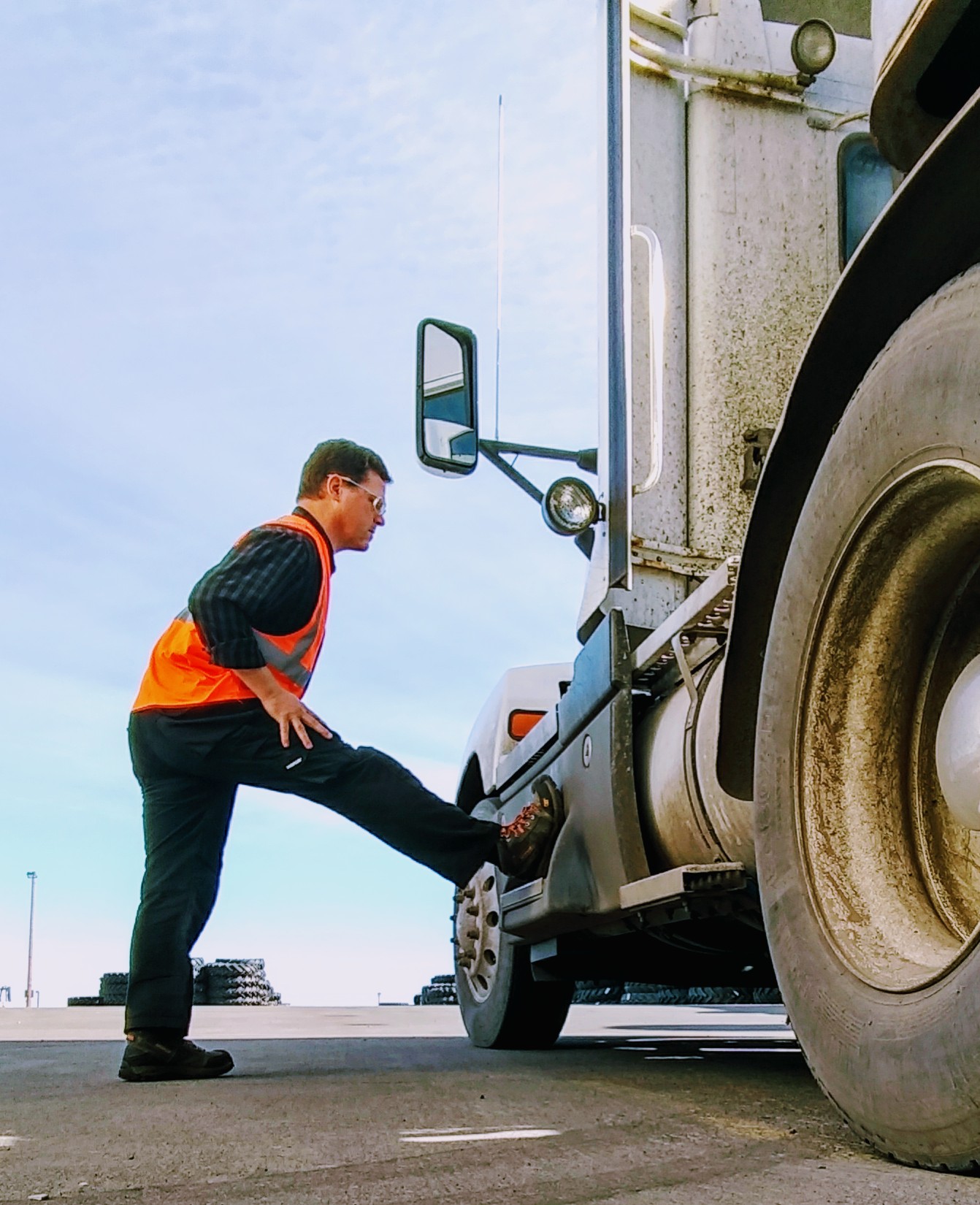
Dr. James Clapper demonstrates a stretching exercise for preventing injuries while trucking.

With a mind to safety, service truck operators often receive extensive training in order to utilize their equipment in a secure fashion that doesn’t put anyone or anything on a job site at risk needlessly.

However, potential dangers lurk in mundane aspects of service truck operations. Without proper care and technique, debilitating injury can be caused by the most innocuous of actions. Los Angeles area chiropractor Dr. James Clapper, a specialist in occupational injury prevention and ergonomics, says it is extremely important that those in the utility industries take proper care to protect themselves.

“In my experience, most muscle, joint and disc injuries are caused by the accumulation of many

little things that eventually add up until something wears down and ‘breaks,’” Clapper told Service Truck Magazine. “Little by little, little things add up into big things. This is common knowledge when bending a coat hanger back and forth or when a slow, persistent leak doesn’t become apparent until significant damage is already done.”

In the two photos above, Dr. Clapper demonstrates a pair of hand and finger stretches that can help avoid injuries that come from long periods spent using a steering wheel and other equipment

Clapper, who presented on this topic at the 2017 International Construction and Utility Equipment Exposition in Louisville, said most people sabotage their own bodies in a variety of “little” ways throughout the day that compound over years. Many don’t even realize how much pressure they are potentially putting on their bodies. Backs, shoulders and other body parts eventually give out after years of accumulated stress yet they don’t have any idea what happened. Even something as simple as sitting in your truck for long periods can have devastating impacts, Clapper says.

Hazards of sitting

“Sitting for long duration causes muscle tightness in the hamstrings and hip flexors, particularly,” said Clapper, director of ergonomics and biomechanics Training for Future Industrial Technologies. “These muscles directly affect the knee joints, hips and low back — all common areas for drivers to experience pain and discomfort. Chest muscles get tight from the arms-forward position, pulling the shoulder joints into an at-risk position and putting tension in the upper back and neck. Gripping the steering wheel causes the flexion muscles of the hands and forearms to be tight as well.”

The solution, Clapper says, is strategic, therapeutic stretches which help to maintain the neutral length of the muscles. The stretches should be done daily, or even several times a day. Tight muscles and tendons are prone to straining and inflammation while joints that are under tension suffer from decreased motion and are prone to arthritis and other degenerative changes over time.

“As we get older, our muscles and joints don’t work like they used to, so stretching is important and necessary,” Clapper said. “Some people roll right out of bed and expect their body to do all kinds of things and it’s not ready! They put themselves at risk. Preparation is needed to reduce the chances of injury in the immediate and in the long run. The stretches we teach, for example, in our training are easy to do, safe and effective. Some common stretches that we all learned back in gym class are more harmful than they are good. The head roll is a good example — rolling your head backwards is not good for the joints in your neck.”

Challenge of changing habits

One of the biggest challenges is changing habits — many workers have been performing their duties in unhealthy fashions for years and will find it hard to change, citing the cliché about old dogs and new tricks. At a fundamental level, however, Clapper says, these people don’t want to get hurt and they have families who don’t want them to get hurt.

“I say it’s not worth being stubborn about holding on to old habits that are just going to get you hurt,” Clapper said. “It’s pretty easy to modify the things you do to be safer once you know how. In our training, we demonstrate this and they feel the difference first hand. Self-preservation is a motivating factor.”

If self-preservation isn’t enough, perhaps employers should encourage workers to avoid actively or knowingly contributing to the development of a preventable injury, which could lead to them becoming a burden on their co-workers or their families. While these injuries cause lost production man-hours on a job site, it’s about more than that. It’s about the quality of life enjoyed.

“It is not OK to work hard your whole life and then end up broken for retirement,” Clapper said. “By then you’ve earned the right to enjoy it and by managing it well, your body can last long enough to allow you to do just that.”

Photos courtesy Dr. James Clapper.

Oil analysis gauges equipment lifeblood

Originally printed in Service Truck Magazine April, 2018

Ken Hill uses a simple metaphor to emphasize the importance of oil analysis: the oil in your equipment is its blood; and oil analysis is like a check-up at the doctor.

Lubricating oils prevent friction damage to equipment parts, acts as coolants, and help drain contamination from equipment when lubricants are changed, says Hill, vice-president of sales and marketing for WearCheck Lubrication Services LLC.

This is doubly or triply important for service truck operators, who have to worry not only about the engine in their own truck, but about the equipment they’re maintaining, as well as supplementary equipment on the service truck.

“Without lubricating oil there, you’re going to end up having a lot of wear generating and a lot of contamination inside the engine itself,” Hill says.

Hill says that labs like WearCheck’s will compare the amount of wear metals in a sample, and the condition of the oil itself to threshold limits established by the original equipment manufacturer. If one sample shows 85 parts per million of iron, and the next sample jumps to 200, for example, it reveals that there is likely some form of major internal wear on the engine.

Know your oil type

“We need to know the oil type,” says Hill, who is based in Manchester, Pa. “We need to know the oil manufacturer, because different manufacturers use different amounts of the additive package that’s in there. So they want all the information the lab can get from the end user, (that) being the make, model of the engine, the oil type and how much oil is in there. How old is the engine? Does it have 500,000 miles or does it have 100,000 miles on it? We look at all that information combined to actually come up with a diagnosis that will be beneficial to the end user themselves.”

Hill says that historically many companies only pursued oil analysis when required by the equipment’s OEM for an extended warranty. However, in the past 15 years, he has slowly noticed more and more attention being given to the topic.

Being aware of how to properly maintain lubricating oils is another matter entirely, though.

“If you’re going to spend good money on the lubricants out there, and you’re going to pay a premium price for it, you need to learn how to keep them clean and dry,” Hill says. “Is it coming out of a drum that’s wide-open on the shop floor? Or is it in a storage system to where it’s contained and it’s locked up?”

Hill gave a presentation on oil analysis at the triennial ConExpo-Con/Agg heavy equipment trade show in Las Vegas in March 2017. According to his speaker’s bio on the ConExpo website, Hill has over 30 years experience in analysis of used lubricants and is certified as an equipment support professional through the Association of Equipment Management Professionals.

He told Service Truck Magazine that you could use the most expensive oil in the world and it won’t make a difference if it’s not properly maintained. Proper maintenance is not just for larger companies with bigger bankrolls. Hill says he often hears complaints from smaller firms about the cost of oil analysis, but he says that neglecting it is a crucial mistake.

Preventing catastrophes

“If I’ve got a truck that I just paid $85,000 for, I definitely want to make sure it’s maintained properly and I want to know when stuff’s going on internally,” Hill says. “If you do have a problem, and it’s under warranty, then you can take it right to the OEM or your dealer and, hopefully, they’ll fix it under a warranty claim for you.”

Hill warns that OEM-mandated oil analysis and oil changing may not be enough. Ordinarily, the OEM will require an oil change every 250 to 500 hours. However, much can happen in those first 250 hours and again between 250 and 500 hours. Monitoring and sampling your oil could help prevent catastrophic failures.

“People are actually starting to pay attention to this, because they’re realizing that by analyzing your equipment on a specific timeline, instead of saying ‘Well, I’ll analyze it if I think I have a problem,’ there’s an internal benefit there,” Hill says. “If you just save a client, say, one engine — these days a Class A engine’s going to run you about $60,000 — that’s going to pay for the analysis program for a couple of years by doing that.”

Tech-savvy oyster farmers retool shellfish supply chain

Originally printed in Aquaculture North America April, 2018

Real Oyster Cult pioneers B2C overnight delivery of fresh oysters from 70 US farms

Contrary to what the name may lead you to believe, there are no secret rituals or sacrifices involved in joining Real Oyster Cult.

“Our hashtag and tagline – #jointhecult – is all about joining, having fun, and is wink, wink, get in on the party,” says Sims McCormick, the creative force behind Real Oyster Cult’s unique marketing. “We’re a cult of oyster lovers, life lovers. Let’s celebrate.”

24698fa7beb5d61d35c8d19d5a5235c1_XL
Real Oyster Cult’s founders Sims McCormick and Rob Knecht provide their members with oysters from farms across the United States and Canada

McCormick’s husband Rob Knecht spent most of his working life on the water, running a maritime school, and working as a sailing coach. When the couple launched the oyster farm in 2006, Knecht also worked with a technology company. At that company, it was interactions with technologists, developers and designers that sparked the idea to build a company that used technology to get oysters directly to consumers, shipped overnight.

“We leverage our mobile app and our website to get in front of consumers online that want to source oysters from all over North America, and we make that happen for them,” says Knecht. “Our front-end technology really gives you access to the farmers, their story, and deeper dives if you’re really into flavour profiles, and details of the oyster and where they’re grown.”

Real Oyster Cult sells product from over 70 farms (including their own), rotating which farms are featured on a weekly basis. Some products will stay longer based on demand, but they make efforts to highlight a new farmer at least once a week through their newsletter and their platform.

Solving the technological and logistic challenges with this model is what Knecht calls their ”secret sauce.”

“We’ve solved some of those issues with technology,” says Knecht. “We not only have our front end technology, but our backend tech helps smooth that process out. Some of them are custom and proprietary, and others are technologies that you can get; whether it’s Slack technology [a cloud-based suite of collaboration tools] or another third party that we implement into our system.”

While Real Oyster Cult has sold oysters to chefs on a limited level, the majority of the clientele is B2C — end consumers who love oyster lovers and adventurous foodies. Knecht says they are riding the wave of Plated, Blue Apron and other ready-to-cook meal kits, which opened a window into people’s buying habits. They have shipped to all 48 continental states and their most popular markets currently include Texas, Ohio, Illinois, Florida, Colorado and Pennsylvania.

However, freshness is important, particularly as it comes to shellfish. As always, Real Oyster Cult answers the challenge with technology.

“We use a little gel temp sensor in our package, which provides a level of security on temperature so that the consumer knows that they’ve stayed under about 50 degrees for the whole trip to their door,” says Knecht.

Cultivating a community

While the business certainly sees booms around holidays, where customers may want oysters for celebrations and events, they also have a monthly cult membership which sends 20, 40 or 60 oysters every month. The cult membership features oysters hand curated by Knecht and McCormick.

“We’re picking some very special oysters based on what’s highly in season and what’s tasting phenomenally,” says Knecht. “They’re going to be at their peak flavours and they’re going to be the best of the best. And we also try to pick what’s not readily available everywhere, oysters you may not find at any restaurant — ones that are only locally sourced, for instance. We like to give our cult members something special.”

The cult theme may be whimsical, but it also refers to a real community and culture which McCormick and Knecht attempt to cultivate. They interact directly with their customers through a variety of platforms. McCormick notes that their Facebook page is currently blowing up with excitement over Glacier Point oysters from Halibut Cove, Alaska.

“They obviously have a really nice community of supporters around them that were able to share the story and comment on it,” says McCormick. “The oysters are truly glacier-fed. Theirs is a great story – husband and wife team, raising oysters, mussels and kids in remote Alaska. We got a chance to tell their story across our platform and on social media last week and the response was tremendous. That’s really what we’re all about, trying to spread the love – give our customers direct access to the farmers and regions that grow oysters and giving the farmers a platform to shine.”

Award-winning

In November, Real Oyster Cult were one of the eight finalists awarded a cash prize at Fish 2.0’s 2017 Innovation Forum. Fish 2.0’s release says the winners were selected for ”simplifying supply chains while increasing income for fishers and farmers, bringing to market creative approaches to aquaculture production and traceability, and getting consumers excited about seafood.”

“We had a great experience there, met a lot of great people,” says Knecht. “Getting to meet folks and hearing about their challenges and different things they were working through at start-up. It was very refreshing. We still keep in touch with the folks that we’ve met through that. Trying to help each other out and network, even on a global scale, is what’s neat about the program, for sure.”

Looking forward, they hope that the networking opportunities that Fish 2.0 offers will help them as they develop their next steps forward – expanding into international markets, and, domestically, moving into a direct chef/pop-up model. But in the meantime, they are happy to grow their cult.

“We’ve had such a great response from people who said, ‘I never would have gotten any kind of live seafood shipped to my door. And I’ve never shucked an oyster before, but I did this, and I watched your video on how to shuck, and taught my daughter and had an amazing experience,’” says McCormick. “That is just so much fun for us. We converted them.”

Women in the crane industry

Originally printed in Crane & Hoist Canada March, 2018

Three former chairs of the CRAC reflect on their careers, growing up in cranes, and their experiences as women in a male-dominated industry.

Cranes and heavy construction have long been stereotyped as “men’s work,” and the demographics of the industry could enforce that perception. The industry is fairly dominated by men. But that perception is changing, as more and more women are establishing themselves as driving forces within their companies and within the industry as a whole.

We spoke to three such prominent women about their experience growing up around family-owned crane businesses, their terms serving as chairperson of the Crane Rental Association of Canada, and their experiences as women in the crane industry.


Sheena BakerSheena Baker – Canadian Crane Rentals

“I’ve been exposed to the crane industry since a very, very young age,” says Sheena Baker. “Growing up, most people had Tonka toys, I had real life-sized heavy equipment and that’s where my love for the equipment started.”

Baker represents the third generation of her family to work in the crane industry. At 10 years old, Baker began by doing cleaning and other types of grunt work for her family’s business – Canadian Crane Rentals in Wingham, Ont. After leaving the industry briefly to pursue an education, she was drawn back in her early 20s.

“We also had a pumping division, so we were running a significant amount of equipment at that time, so we needed extra help,” Baker recalls. “I came back just to temporarily help out for a little bit and rekindled that interest in heavy equipment and running a business; and learning more about what goes on in the field of a construction site, multi-site projects, that type of stuff. I started there and built on that to what I do today.”

Baker worked on the safety side of the business initially and slowly added more and more skills – learning what size equipment would be needed for which projects, dispatching, managing employees, overseeing the shop floor and overseeing the operators. Today, she serves as operations manager.

Her brother technically works underneath her, but there is no sibling rivalry.

“He’s running the equipment but he has no interest in actually managing the business,” she says.

There were no gender roles in their household growing up – if her father needed help fixing the car it fell to whoever was handy. They were both treated the same and exposed to the same things.

Baker is also an owner and instructor for Huron and Bruce Safety Training. Grown out of her experiences focusing on safety within Canadian Crane Rentals, she saw a need for training options that were more affordable for smaller businesses.

“I understand the risks that they’re being exposed to. So, from an instructor standpoint, I don’t just have a book that tells me, I actually have hands-on experience,” says Baker.

Canadian Crane Rentals has been associated with the CRAC since the beginning. Her father is currently serving his third term on the board and was also president. Baker herself served on the board for six years and was president last year.

“I was very grateful that they accepted somebody, relatively very young in the industry,” says Baker. “I was only in my mid-20s when I was nominated. There was no, ‘I’m older, I’ve been around longer. Can we trust you?’ It was very well diversified between anyone on the board – everybody’s opinion mattered.”

One of Baker’s proudest achievements with CRAC was putting an enhanced focus on the safety aspect of the business – getting information about what’s happening in the field, what the trends are, and getting the forum to discuss how to deal with those issues. She was also very happy to provide a voice to smaller companies in the industry, such as Canadian Crane Rentals.

Shawna Boreen
Shawna Boreen – Sarens

“My father owned a crane company and I drew the short straw,” jokes Shawna Boreen.

At a young age, Boreen was extremely interested in business.

“Even as a young kid, I would read the business section of the Edmonton Journal, totally nerdy,” she says.

After finishing her university degree, Boreen worked for her father’s company, King Crane Service Ltd. There, she worked in the office and came to understand the basics of what her family did.

The biggest lessons she learned from her experiences working with her father were about decision-making and leadership – how it’s not about always being right, but about being able to make a decision that helps the team get to where they need to go. Her father entrusted her with responsibility early on and was adamant that she develop the skills she would need.

“One of my first tasks in the crane industry was to get a loan for my dad to buy a crane,” says Boreen. “I had to go to the bank manager and said, ‘Mr. Simpson, I’m here to get a loan’ and he said ‘I don’t ideal with you, I deal with your dad,’ and he sent me away! So I came back to my dad and he’s like, ‘Get back there, you’re the future. You’re going to learn how to get a loan from a bank.’ I had to go back to see Mr. Simpson and I said, ‘I’m more afraid of my father and going back without a loan than anything you can do here.’ And I got to write a check with more zeroes than I’d ever seen in my life.”

She remained with King Crane Service until its closure. Following that she did some freelance work for other crane companies on specific projects, from the opening of a new branch, to helping with health and safety aspects, to managing rough terrain crane fleets.

During a lull between jobs, she was approached by Sarens and became their special projects manager. Currently, she is based out of Nisku, Alta. serving as senior project manager and site manager for the company.

In the early days of the CRAC, her father was asked if he would like to sit on the board – he declined, but suggested Boreen would be a good fit. She became a board member and would go on to become chair in 2006. She did a lot of community and committee work with the association. She will finish her third tenure on the board this May. She says she was particularly proud of the CRAC conference she was in charge of in Kelowna, B.C. in 2006.

“What I bring is a sense of collaboration and communication. I think those are my strengths as a leader,” says Boreen. “We helped to really establish the spousal program with regards to having some value for the spouses who attend, men or women, and we really developed that. We were really diligent in ensuring that the speakers we bring are informative, are relevant to the times and can speak to the issues that are of a nation instead of just specific areas.”

crane 1053 copy
Valerie Brennan – Amherst Crane Rentals, Ltd.

“I was one of the oldest, so the kids all got involved in helping right from the get-go in one way or another,” says Valerie Brennan. “I began to do invoices for my mother when I came home from school and I helped her with some of the bookkeeping. It was a family business, no question about that.”

Brennan’s father started his company – Amherst Crane Rentals Ltd. – in Scarborough, Ont. in the early 1960s as a one-crane operation. Brennan began working in the company’s office, but started getting very hands-on with the equipment shortly after her father bought a full shop.

“I liked to be outside, so I got into the shop and got involved in watching what they do and why they need things and what broke down and learning a lot about it,” Brennan says.

Brennan took a brief sabbatical in her early 20s, working in the Caribbean islands. When she returned, she began working for Amherst as a bookkeeper and developed further skills in other aspects of the industry.

“It was all just continuous learning and an enjoyment of working with the people in the industry who I find very creative,” Brennan says. “Art and music and cultural things have always been a big part of our lives. My parents were like that and taught us that. So the construction industry sort of follows suit – the people that you need in this business are builders. They always have great ideas and strong conviction, so they move ahead and build. I enjoy that environment, so I’ve made myself a big part of it.”

Today, Brennan says she touches on all aspects of the business – perhaps not as an expert, but well-versed in all of it. She has participated in the development of education for crane operators and has sat on committees with the government for regulatory bodies. She manages the office and staff, and helps with legal issues while also being a capable crane operator, and able to cover for a dispatcher, if need be.

Brennan, and Amherst, joined the CRAC in its second year of existence. Brennan thought it would be wise to join it as a social club and networking opportunity, to get to know people in the industry who had the same type of machinery, the same concerns and the same dealings with manufacturers. Eventually that social club evolved into what the CRAC is today.

“Now it’s becoming more of a voice,” says Brennan. “Obviously, there are projects that are more connected in Canada, so it’s more sophisticated than it was 15 or 20 years ago. It’s been a great asset to already have that base.”

Brennan is particularly proud of the work she was able to contribute to with CRAC, including Red Seal training and a current project looking at law surrounding heavy machines and their impact on the road. She was also very proud of the CRAC conference in Toronto during her time as chair, where they brought in elephants and other animals from the Bowmanville Zoo, based on an incident where cranes were used to rescue elephants that had slid down an embankment at the zoo.

As women in the industry

There was a time when the crane industry was something of a boys’ club. While there have been exceptions going back many, many years (see story on WWII-era crane

operator Rose Grant Young in the October 2016 issue), attitudes and perceptions have persisted. It has been the contributions of women like the three we spoke to for this article that have worked to help reverse those trends. But it hasn’t always been an easy path.

“There’s quite a few challenges being a woman, I think, in any trade,” says Baker. “Bullying is a big factor. Being taken seriously is a huge obstacle that women undertake every day. You can have the same education, you can have more experience than a male. If you say something, the exact same, often times in this industry, they will take a male’s opinion over a female’s opinion.”

Baker says the first time she entered the classroom to get her crane licence, the instructor asked her if she was supposed to be there. She got the impression that he was thrown off by having a woman in his classroom. But by the end of the course, she had proven her aptitude and knowledge and “his tune had very much changed.”

Boreen wouldn’t say she had experienced challenges specifically as a woman, but rather as a new person within the crane community. She credits the men she has worked for as having been extremely generous in their mentoring.

“You start off trying to be what they want you to be, but at the end of the day they accept you for who you are,” says Boreen. “That’s probably the voice we have to give all young men and women in industry – to be who you are in those industries, not a reflection of your gender. The people I work with know my weaknesses and my strengths and we try to put those puzzle pieces together so we have a really strong team. The fear that I had as an individual, I think a young man in the industry would probably feel, too.”

“There are always some challenges over the years, but I’m the kind of personality that let’s that just run off my shoulder,” Brennan says. “I’ve encountered, occasionally over the years, men who have fast attitudes about women, but as Winston Churchill might say, ‘There’s always opportunities to keep your mouth shut.’ I understand that people have their prejudices, so I find ways to work around it and educate them and encourage them slowly rather than confront. It’s worked well for me over the years.”

Brennan says that there may be hard feelings over someone showing themselves to be more capable than someone else, but that would be the same with a man or a woman. They may use being a woman as an excuse, she says, but it’s just that – an excuse. Brennan sees a different “culture of men” and that rather than trying to change it, she looks to make the most of it.

“I’ve worked with strictly men almost, for many, many years of my life,” says Brennan. “I’ve enjoyed that. I can use my feminine power, if that’s what they like to call it these days, to my best advantage without taking advantage of people. At the same time, I understand that some men have to have their pride, and that’s good, and we can work with that.”

And what advice would they have for young women interested in entering the crane industry who might be concerned about such issues?

“If you’re concerned about those issues, don’t enter the crane industry,” says Brennan, bluntly. “If you are willing to confront the issue and learn how to cope and improve it and educate, then you will succeed in this industry, because that is what these people are looking for. They’re looking for empowered individuals, male or female.”

“Go for it,” says Boreen. “Don’t let your own fears stop you from the dreams that you have to have to be in the profession of your choice. There’s people on the other side who will support you, mentor you and will make you a success. We are in an amazing, vibrant industry that you can learn, have lifelong learning, and an amazing career as a woman in the crane industry.”

“I really encourage women to try it,” says Baker. “We need to fix this gap in the labour shortage, right now, in trades. And women can help close that gap. Some people think that it’s just dirty and male dominated. It’s hard labour. It’s not for women. We really need to break down those barriers all across the board, but specifically in the crane industry. Take that risk and start to fill those gaps in our industry. We are capable of doing anything that a male can do.”

Norwegian company brings cool concept to live feed

Originally printed in Hatchery International July 2017

As the arms race to develop more efficient and effective live feeds for hatchery applications continues Norway’s Planktonic AS has developed a unique approach which they say could be a game-changer for the industry.

The process includes a method for harvesting large amounts of plankton from the ocean, which is then cryopreserved. The plankton is packed in sacks of 600g, corresponding to about 30 million plankton individuals, and these are stored in thermos flasks with liquid hydrogen. When this feed is to be used, it is thawed in seawater, and the plankton then becomes live again and therefore constitutes a natural feed for the juvenile fish.
cryoplankton
A size comparison between juvenile lumpfish from the same egg batch – the ones on the left were fed traditional dry starter feed, the larger ones on the right were fed live Cryoplankton.The right stuff

“The right marine fatty acids in the earliest live stages are crucial in order to release the potential for growth in marine fish,” says Rune Husby, CEO of Planktonic AS. “Natural zooplankton contains these fatty acids and is such a superior feed to any other feed type out there. This is well documented in literature and publications, but there has been no effective way of presenting such a feed to marine hatcheries that made industrial sense. Until now.”

Husby says that to utilize their live feed, a hatchery manager need only throw the cryopreserved nauplii into sea water and within eight hours they are ready for use. A much simpler, less expensive and less time consuming process, Husby says, than cultivating a batch of rotifers or hatching artemia cysts or cultivating algae for feed.

Maximizing the gains

“Less work, faster growth, improved pigmentation and reduced mortality will certainly contribute to better economics for the hatchery manager,” says Husby. “In addition, reduced microbiological activity in the fish tanks reduce the need for cleaning the tanks. The fish will experience better health and lower mortality. The immune system will benefit from the right type of feed and we have conducted studies ourselves showing that fish getting our feed better cope with stress than fish given traditional feed.”

Transporting Planktonic’s feed requires a cryo-container to maintain the temperature. “It’s not like you can take it in a suitcase and carry it on a plane, but I think it’s quite efficient,” adds Husby.

Planktonic AS was formed initially in 2008 by Nils Egil Tokle, a PhD in marine biology, and Haavard Aakeroy, a mussel farmer and co-owner of Norway’s largest mussel producer. The company was formed initially to focus on inert feed, but in time developed the cryopreservation technique.

“They started experimenting with this in a small scale and had a little bit of a hunch as to what species that this could actually work with,” says Husby. “Due to both extreme creativity and in-depth knowledge about zooplankton biology, they could actually leap-frog a lot of stages that people otherwise would struggle with for years. When we discussed this with people from either academic circles or people from the cryopreservation business, they are struck with awe that this is actually possible with an organism in this context.”

Biggest challenge

The biggest challenge for the company currently is producing enough product to meet demand. They currently sell everything they produce. Expansion of their business will require proportional expansion of their operations.

“It’s about purchasing equipment,” says Husby. “It’s about making the equipment even better, and actually doing everything we do a little bit better. So, it’s all about industrializing the process and being able to produce even more tons than we do today. We have to make sure everything in all departments is working efficiently.”

Canada’s tallest crane renovates Montreal’s Olympic Stadium

Originally printed in Crane & Hoist Canada May 2 2017

In 2018, more than 1,000 employees of Desjardins, North America’s largest association of credit

unions, will be setting up their new shop in the tower of Montreal’s Olympic Stadium. Before they can move in, however, the tower will require surface renovations. And performing renovations that high up in the air will require the use of a giant Liebherr 630 EC-H H 20/40 Litronic tower crane. The crane, along with a Liebherr 710 HC-L, will be used for the next two years to maneuver workers around the sides of the tower so they can perform their tasks.

“The building is a beast,” said Mark Forbes, Morrow Equipment’s branch manager for Canadian operations. “I think that’s the best word to use for it. There are many different construction processes and elements in the building that led to it being a big challenge to find a crane solution that would reach all points. That was definitely a joint effort with Pomerleau, Liebherr and Grues (J.M. Francoeur) combined. It took everybody combined to find a solution.”

Much prep work needed

Each company played a key role in the operation. Morrow and Liebherr supplied the big cranes whiles Grues J.M. Francoeur provided the mobile cranes and crew used to set up the larger ones and Pomerleau brought their expertise in planning and project management. And each needed to work in concert to keep this complicated project moving forward.

The installation of the Liebherr 630 EC-H required a great deal of prep work. First, a Grues J.M. Francoeur-owned Terex Demag CC2800 was employed with an 84-metre main boom and 96 metres of luffing jib. Due to space constraints, the CC2800 was erected and then walked across 6,000 tonnes of compacted soil into the proper position.

“We had pretty close to 300 crane mats to walk the crane from the erection to the installation,” said Pascal Francoeur, director of operations for Grues J.M. Francoeur.

The CC2800 then set to work building the Liebherr 630, an operation that also required special preparations. In order to reach all sides of the tower, the crane had to have its base set up inside the stadium itself. This required careful preparation, utilizing devices to maintain the fabric roof’s tension even after a section was cut out for the crane.

With the 630 EC-H constructed, the next step was the construction of the 710 HC-L. This required the use of a brand new Grues J.M. Francoeur-owned Liebherr LTM 1500-8.1 with 36 meters of main boom length and 56 meters of luffing jib length. The 710 HC-L was to be installed on the curved “spine” of the building, just above the track for the exterior elevator. Building the crane and its base in that location made the LTM 1500-8.1 the ideal piece of the equipment to utilize.

A mobile and flexible machine

“We could get into that small space,” Forbes said of the 1500-8.1. “The advantages were the capacity required. It was a very long radius to erect the 710 HC-L. The HC-L is modular, and it worked perfectly to erect the crane in a small space and then to manage those capacities required to install the 710 HC-L.”

“It was easier to take this crane because of the ease of moving it around the job site,” Francoeur said. “It was easier to use, it’s more mobile and is more flexible.”

The 1500-8.1 will be used to take down the 710 HC-L upon completion of the project as well. Moving forward, maintenance on the project will be split between Morrow, Pomerleau and Grues J.M. Francoeur, along with daily maintenance performed by the crane operators. Such maintenance will be essential as the cranes will see a great deal of use over the next two years.

“We have a very demanding schedule with both cranes and we’re working with all three companies to ensure that they work flawlessly through the entire project,” Forbes noted.