Mechanics share tales from one of the greatest action movies of all time.
(Originally printed in Service Truck Magazine, Oct/Nov 2025)
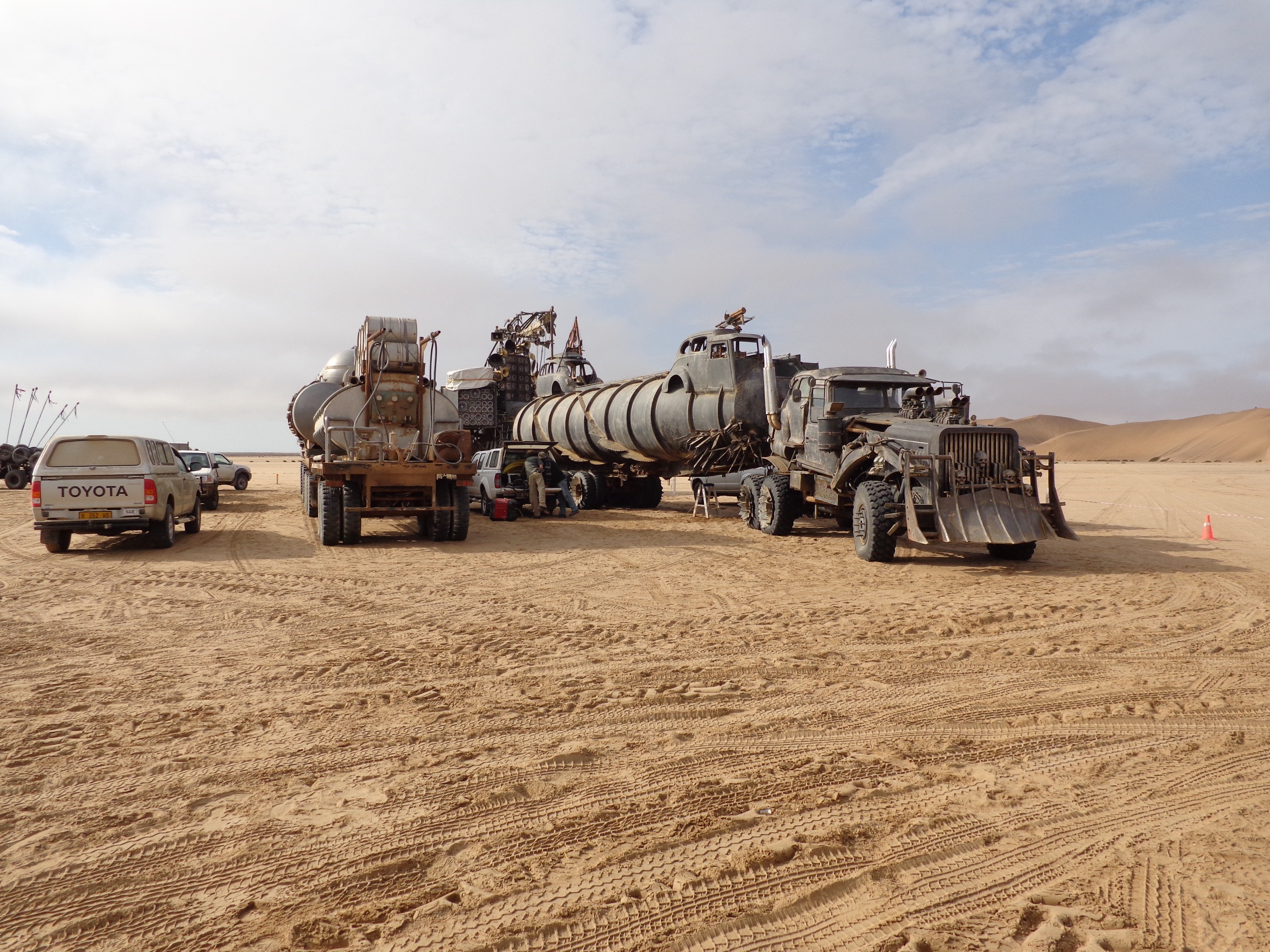
It was a decade ago (2015)—after 30 years of dormancy—that the Mad Max film series came screaming back into theaters. Mad Max: Fury Road starred Tom Hardy as series’ protagonist, post-apocalyptic ‘road warrior’ Max Rockatansky, along with actors Charlize Theron and Nicholas Hoult. It was the highest-grossing film in the series ($380.4 million worldwide), was nominated for 10 Academy Awards, and has been lauded as one of the greatest action films of all time.
And besides the breathless pace and shockingly good storytelling and character development for a film with so little dialogue, Director George Miller continued his series-long love letter to automotive mayhem. Fury Road featured extensive scenes with fanciful and massive vehicles in a deadly chase across the desert wasteland. With Miller interested in doing as many things as possible for real on camera, this meant that the massive vehicles like the iconic War Rig, the Doof Wagon, and a whole fleet of others were constructed and actually filmed traversing and crashing around during a lengthy shoot in the Namibian desert in Southern Africa.
Readers of Service Truck Magazine are no doubt familiar with the challenges in keeping large-scale equipment serviced and running under relatively good conditions. But keeping such vehicles in operation in a windswept desert was an entirely different matter and required a platoon of mechanics and mechanic trucks. To find out more, STM spoke with two of the mechanics and fabricators who worked on Fury Road— Scott Cole and Mark McKinley.
To keep you, the reader, amused every one of the subheadings from here on out is a line taken from the movie as we found many parallels between the characters’ struggles in the post-apocalyptic wasteland and the mechanics’ struggles in the Namibian desert.
“Have You Done This Before?”
“Many Times”
The initial idea for Fury Road came to Miller a few years after the 1985 release of Mad Max: Beyond Thunderdome—to do a film in the series that was “almost a continuous chase.” Throughout the ‘90s, Miller further developed the story idea, and the film began pre-production in the early 2000s, with the intention of bringing back Mel Gibson, who had played Max in the first three films (Sigourney Weaver was said to be considered for the female lead role, which over time evolved into Theron’s role, Furiosa).
Meanwhile, between the conception and pre-production of the film, Mark McKinley’s long career in film had started by chance—he was an apprentice to an Australian mechanic who worked in fabrication and repair for film productions, who eventually double-booked himself. The mechanic asked McKinley to take over for him on one of the productions, which ended up being 1994’s Sirens. In the ensuing years, he would provide mechanic’s work for everything from The Adventures of Priscilla, Queen of the Desert to The Matrix Reloaded. He was contracted by Miller’s production company, Kennedy Miller Mitchell, for the initial pre-production for Fury Road and helped to develop many of the large vehicles.
“There was only a handful of us,” explained McKinley. “Anything to do with the mechanic side of it, I would be designing elements into the vehicles. Not so much the look. When we eventually did build the vehicles for Fury Road, there were some elements that I was picking that weren’t in the original designs. I’d get the designer, Colin Gibson, to come and have a look, and he’d say, ‘Yeah, that looks alright, we’ll go with that.’ If I thought of something that would work, I’d try it.”
McKinley said that occasionally, debate would emerge regarding the form and the function of the vehicles. While Miller or Colin Gibson (who would win an Academy Award for production design for the film) could be more interested in aesthetics, McKinley was focused on mechanical logistics. These types of creative discussions continued throughout the pre-production of both Fury Road and its 2024 prequel, Furiosa: A Mad Max Saga. For example, McKinley noted that there was one vehicle design that he, Gibson, and the other mechanics in the workshop were extremely excited about for Furiosa, but it was not what Miller wanted.
“It was a little bit disappointing that we never got to build our big mean vehicle,” said McKinley. “But I don’t want to make a big hoo-ha about that, because it’s all George Miller’s choices, you know?”
One hopes that the ‘big mean vehicle’ may resurface on HBO in an upcoming television series, rumored to be titled Mad Max: The Wasteland, but with McKinley’s recent retirement, he’ll have to wait to see it in theaters with the rest of us.
The initial production of Mad Max: Fury Road was indefinitely postponed due to a variety of factors, mostly relating to the fallout of the terrorist attacks of September 11, 2001, including the value of the US dollar against the Australian dollar and travel, shipping, and security concerns. A handful of vehicles already produced by McKinley et al would go into storage for the better part of a decade. After production was postponed, Miller briefly considered producing Fury Road as a Japanese-style anime film but, soon returned to his original vision, and preproduction began anew in 2009.
“Being Spared For Something Great”
Scott Cole joined the production in early 2010. Like McKinley, his entry into film was somewhat by happenstance. His brother-in-law, who worked in special effects, knew that the film was hiring mechanics and encouraged Cole to apply for the job. He has since gone on to work on everything from Pacific Rim 2 to the remake of I Know What You Did Last Summer. He was involved in the preproduction and design of several of the large vehicles, including the War Rig, the Doof Wagon, the People Eater’s Limo, and others. And while his task started with just trying to realize the producers’ vision, he was soon allowed to assert his own creative and mechanical influences.
Cole agreed with McKinley’s observation about conflicts between form and function. It would be one thing if George Miller were the type of director who would be happy using green screens, CGI, or other techniques to fake all the action in his movies. It would be easy enough to build a War Rig if all it had to do was sit in front of a green screen, and the movement and action were to be added in later.
“No, he wants every functioning aspect of it,” Cole mentioned. “So you can use that to detail, like redressing the two speed buttons on the gear shift so they’re leather-bound and stick rivets or something in them. They look beautiful, but there’s still a functioning object. It’s got to be functional and pretty at the same time. They thought it was just a pretty thing on the gear stick, but it was functional.”
Asked which vehicle that he helped work on that he’s most proud of, Cole doesn’t hesitate to say the War Rig—a nearly 80-foot-long 18-wheeler built around a Tatra T815, massively customized, including attaching the rear of a 1947 Chevrolet Fleetmaster to extend the vehicle’s cab. Three War Rigs were constructed for the shoot, and while the finished product carries the metaphorical thumbprints of a whole host of bodybuilders, steel manufacturers, welders, and others, Cole can directly see his influence on the final product.
“I built all the exhaust on that vehicle—the air cleaner, the way it’s mounted,” Cole explained as a-matter-of-factly. “The way it was mounted originally, when it got folded up, it just had sharp edges on it, but I went back and remade the same round loops that hold the air cleaner on one side of the truck and put little turn-ins on the side of it so no one could get caught.”
As part of the ‘lived-in’ aesthetic of the vehicles in the film, the crew responsible for ‘dressing’ the vehicles would include details like tools and equipment that characters could use to keep them running. Cole related that he would request that they use real tools for those purposes. Then, if he or another mechanic were working on one of the vehicles and needed something, they could just use one of the prop tools if it were handy.
“Out Here, Everything Hurts”
While some parts of the film were shot in Cape Town, South Africa, and a few locations around Australia, the bulk of the film was shot in the Dorob National Park in Namibia. McKinley was the head mechanic for the shoot, and Cole is credited as a truck mechanic. In total, the film employed 22 different mechanics (23 if you count actor Angus Sampson, who played the character The Organ Mechanic).
Cole stated there were three crews of mechanics and mechanic trucks: one focused on cars, one on motorcycles, and one on trucks and larger vehicles. As one would expect for a shoot in the desert, air cleaners were a priority item to stock on the truck-focused mechanic trucks, though spare oil filters were also in high demand.
“We’d carry brake boosters, we had to have a spare turbo, we had a spare intercooler, we had spare tires on rims, we had spare panels,” Cole said. “We didn’t carry the tires and the rims in that truck; they’d come on something else. But we’d have spare body panels for the War Rigs’ trailers. We’d carry spare doors if something got damaged. We’d have spare glass for any of the windows in there. You’d carry huge amounts of air fittings, oils, and coolant. It just went on and on. If you didn’t have it, you’d need it.”
In addition to the trucks being loaded for bear, the mechanics themselves had to be filled with knowledge. Between all the different large vehicles, the truck mechanic team had to know the ins and outs of working with Tatra, Cummins, and MAN, among other engine types.
If a problem were more extensive than the teams could handle in the field, there were also a few other options nearby. A large warehouse in Walvis Bay, Namibia, was turned into a ‘home base’ where damaged vehicles could be attended to. Cole also describes several shipping containers having been stacked with a domed roof on top to create a makeshift aircraft hangar, which served a similar purpose.
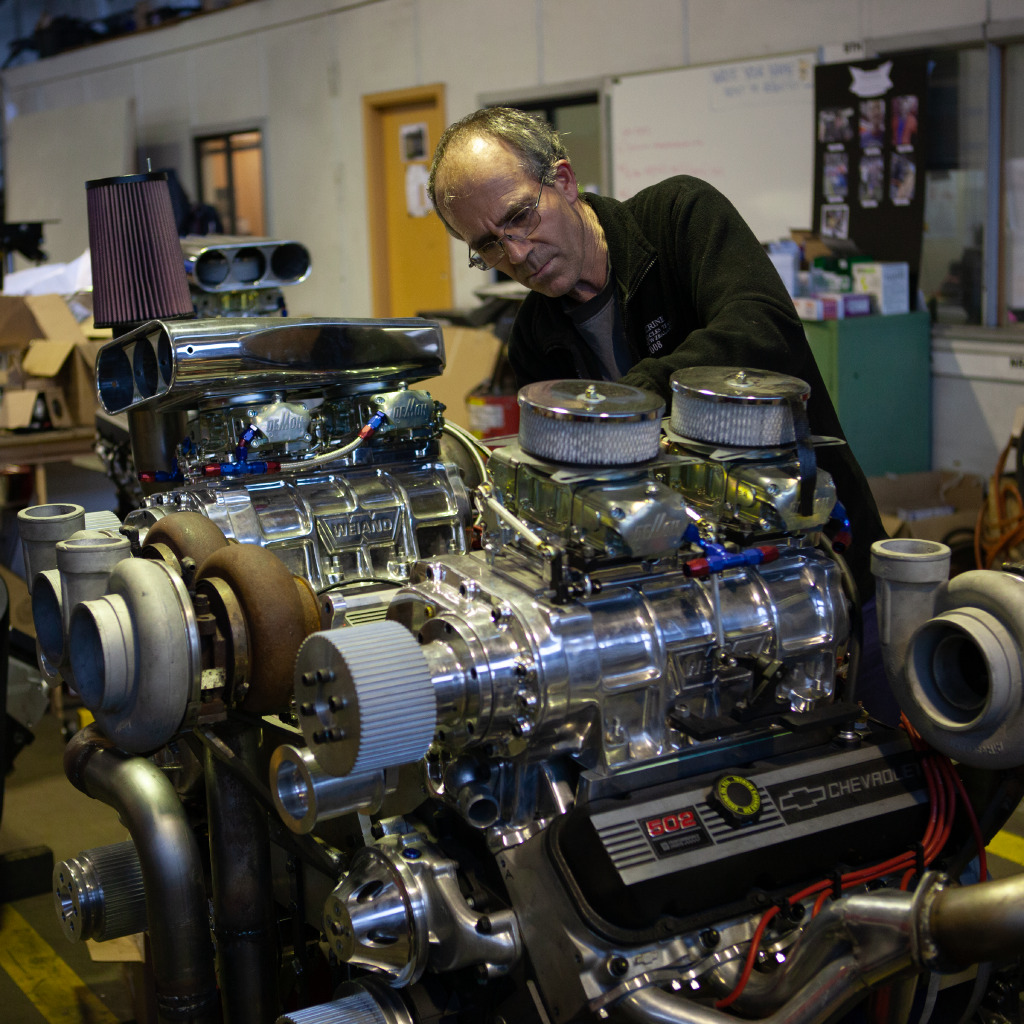
Below: Mark McKinley working on the engines of the Gigahorse vehicle, during the pre-production of Mad Max: Fury Road (photo courtesy John Platt).
“160 Days Ride That Way… There’s Nothing But Salt”
Mist was one of the biggest challenges the team faced. McKinley explained that every night there’s a salty sea mist that comes off the ocean—possibly very beautiful to look at, but incredibly corrosive to any exposed copper cables that were part of the vehicles.
“If it was exposed, they were just turned to green mush,” McKinley stated. “[A vehicle] would start one day, and then the next day you’d go to start it and you’d have nothing. It just wouldn’t start. You’d track down the main cables and say, ‘Oh, there it is; it’s all goo-ed up.’ So we had to replace some of the connections and things.”
Cole described standing in that fog in the pre-dawn hours as being the same as standing in rain. But while that may sound like copy from a tourism brochure, when that saline mist is causing massive issues with rust and corrosion, the potential beauty of the moment is severely undercut.
“Things like S Cam Anchor pins were rusting up,” said Cole. “The clevis actually seizes in the S Cam adjuster. You have to spray them every couple of days so that doesn’t happen again to you. You get under there, and you gotta whack him with a hammer and free him up, and then spray him again, and away you go again.”
McKinley said that the team would generally start their day getting the trucks warmed up and ready for the stunt drivers to pick them up. And, after dealing with whatever situations and emergencies arose during the day, they would make a point to perform service on the vehicles every night, largely driven by how air filters needed to be changed frequently.
“The fine dusty silt,” recalled Cole. “You can have a camera vehicle running in front of a truck as it’s running down the road, and it’s running through the sand, and it’s sucking up all that shit. You don’t see it so much, but you’re blocking the air filters. Within a week of running in the desert, you’re throwing away an air filter, and you’re throwing a new one in to maintain that everything’s good.”
“It was a hellishly dusty environment that they were all working in,” added McKinley. “So that was a mission, changing filters, going over for loose nuts and bolts and any oil leaks, and during the day we had a fuel truck going around keeping all the fuels topped up, which was good; something we as mechanics didn’t really have to look after.”
Cole said another common task they had to perform was bleeding air out of the systems. A large liquid-filled pneumatic ram system was used in the War Rig, but within a few weeks, they found that when left overnight, air would be sucked back into the system because the coolant is thinner than water.
“So first thing in the morning, you’d go and jump in the truck, fire it up, air it up, go to take off, and the gear stick would feel like a big wooden spoon stirring a bowl of porridge,” said Cole. “So then it was engine covers off, use the air from the truck to pressurize the coolant tank—which is just a reservoir for the gear shift, clutch, and brake—push it out, bleed it out, get the bubbles out of it, and release the pressure out of it. These things went on day after day, religiously.”
“If You Can’t Fix What’s Broken, You’ll Go Insane”
Complicating matters was that to access the engine systems of the War Rig required removing two separate heavy hatches. Cole explained that there were many times when, halfway through the day, while actors and set dressers and other crew might have been on lunch break, he or other mechanics would be working to ensure the War Rig was ready for the afternoon’s shooting.
Cole recalled one day when some Dynex (a heavy rope often used in stunt rigging) became ensnared in the brakes of one of the War Rigs. An assistant director asked how long repairs would take. Between all the disassembly, repair work, and reassembly, Cole estimated an hour and a half. The assistant director decided that they couldn’t wait that long, so he called in one of the other War Rig vehicles. However, the second War Rig needed to be ‘dressed’ so that it matched the part of the movie they were shooting.
“So they go and get the other truck, and they’re sitting beside each other,” said Cole. “They start dressing it, and by the time they’re finished dressing it, I’ve got the wheel off, the drum off, the Dynex off and fixed back together, and I go, ‘You could have taken this one.’”
Another situation that stood out to him was during pre-production in Broken Hill, Australia, where a stunt test was conducted with one of the War Rig vehicles. They were practicing for a scene where a vehicle explodes in front of the War Rig when the engines on the big truck cut out entirely.
“What had happened is that the unit was engulfed in flame, and it burnt through the intake, burnt the air cleaner, and as that was burning, it goes down into the turbo,” recalled Cole. “So we did the turbo and air cleaner in one hit. So that’s a lesson learned. ‘Let’s not do that again,’ so that never happened again.”
Asked if any specific incidents stood out to him, McKinley demurred, “No, it’s all a bit of a blur.”
“Where Must We Go… We Who Wander This Wasteland In Search Of Our Better Selves?”
Both Cole and McKinley would go on to work on the follow-up, Furiosa: A Mad Max Saga. And both said that they found it incredibly rewarding that they were able to use their experience from the previous film to exert influence over the sequel. Both identified the remote driving rigs—sometimes called ‘pods,’ where a stunt driver will control a vehicle from an external attachment so an actor can be filmed naturally behind the steering wheel—as an area for improvement.
“When Furiosa came along, I had a bit of a word with the special effects people,” said McKinley. “I said, ‘Look, we can’t have it like we had it in Fury Road; it was really problematic.’ There are other ways of doing it, like just extending systems rather than implementing another system to make these remote driving rigs work. Just extending systems was far better, and we didn’t have anywhere near the problems.”
Cole was asked by Colin Gibson for input, so he suggested doing away with manual gearboxes.
“It’s hard when you put a drive pod on the side of them,” said Cole. “It was all easier to do wiring than to do silly gear changes. Now that I’m older, I get more input… In your first movie, you can’t tell people that they’re stupid or ‘you’ve got to keep it simple.’ But now, 15 years later, I tell people that it’s got to be KISS—Keep It Simple, Stupid.”
Now retired, McKinley reflected on his career in film with obvious pride. However, when asked which job he worked on was the most impressive in terms of scale or logistics, he actually cited his work on the opening ceremonies for a variety of sporting events, including the 2000 Olympics in Sydney, Australia, the 2015 European Games in Baku, Azerbaijan, and, in particular, the
2006 Asian Games in Doha, Qatar.
“That was fabrication and a lot of design work as well,” recalled McKinley. “The pinnacle of my career was probably the Asian Games in Doha because it was quite a technical show, and I was the head mech for everything out of the field of play.”
Cole has typically bounced between his work in film and more traditional mechanic’s work, but in the past five years, most of his work has been in film. To hear him speak, it is readily evident that he finds the work highly rewarding.
“It’s great,” summed up Cole to Service Truck Magazine. “You’ll get to the end of a movie and you go, ‘I’m over this, I’m not going to do this anymore,’ and within three weeks you want to know when the next one is.”
 mattjoneswrites