Category Archives: Uncategorized

Canada’s wartime Rosie worked as crane operator

Originally printed in the Fall 2016 issue of Crane & Hoist Canada

In June 1943 in the Whitney Pier area of Sydney, N.S., a young couple was seeking a marriage licence.

“What’s your occupation?” the clerk asked as he filled out the application form.

roseroyjune2943

Rose and Roy Young post for a wedding photo on June 29, 1943.

Roy Young, the would-be groom, replied “craneman.”

The clerk wrote it down and then asked Young for his fiancée’s occupation.

“Craneman,” he replied again.

Obviously, the gentleman had misunderstood, so the clerk clarified he meant the bride-to-be’s occupation. Undeterred, Young insisted: “Craneman.”

The clerk was shocked. “My god, man, I can’t put that on the certificate!”

Eventually, Rose Grant and fiancé Roy were able to convince the clerk that she had indeed worked the crane at the rail mill in Whitney Pier. The clerk noted her occupation as “cranewoman.”

Women kept industry running

Rose Grant Young was one of many women who took over what had been traditionallyconsidered men’s jobs during Second World War conscription. The contributions of Grant Young and other women like her kept the wheels of industry and production spinning at home while young Canadian men were sent into combat overseas.

Rose’s father died before her second birthday. She and her sister were raised by their mother who made ends meet as a dressmaker. Rose began work at a general goods store, but soon sought out more lucrative work.

“At that time, my mother was in financial difficulties,” Rose told Cape Breton Magazine in 1984. “I asked for a raise at the place where I was working, and I didn’t get too much satisfaction. So when I heard that they were taking names on the plant, we went over and put our names in.”

Rose and other applicants were taken in for training — whoever took to the training quickest would get the jobs. There were no certifications or qualifications required.

“Back then, you were given training, but it would have been as if you were training at Tim Hortons right now,” said Rose’s daughter, Valerie Young Levesque, in a recent interview with Crane & Hoist Canada. “You had someone who told you, ‘This is the way it goes; this is the way it works,’ and if you caught it and could pick it up and do it, you got the job.”

Rose started crane work in a plate mill, where she learned simple lifts in a controlled environment. She proved adept enough that when a position opened in the rail mill, her superintendent motivated her to go for it.

“He told me, ‘They tell me a woman will never run the rail mill crane. You and I are going to prove them wrong!’ He was quite the psychologist. And, of course, that’s all I needed to hear, was that the men were against the women; in other words, that made me try that much harder.”

Training starts with a shock

Two candidates — Rose and another woman — were trained in the rail mill by a father-son duo. The son, who was about to leave for war, trained the other woman. The father, named Maynard, trained Rose. In a 1991 interview with The Beaton Institute, Rose described being brought into the chaos of the rail mill and where Maynard would teach her to run the 12-foot-high crane.

“I looked and there was hardly two inches that there wasn’t something in the way, and I thought to myself, ‘How in the name of God can I do any work in this place?’ This was the rail mill, where they roll the rails. And this great big housing, it’s like a house but like a jigsaw puzzle. You take it apart and you put it together for different size rails and all this. I thought the man must be a magician.”

Her first day training under Maynard was a rough start — she was electrocuted when she touched a charged billet while climbing into the crane.

“Where did the electricity come from, to run the crane? Never, ever dawned on me, you know. First thing I did was put my hand on one of the billets and I was caught, you know, couldn’t get my hand off. Nobody ever explained anything like that.”

In time, however, Maynard did teach her everything she needed to know to do the job. His training not only taught her the execution of the lifts and maneuvers in tight spaces, but he also taught her how to do her own repairs and maintenance.

“He was a fantastic operator,” said Rose in 1984. “He had been there for 35 years. He taught me how to pick up the boxes with the scrap in, take it down, dump it, bring it back. He taught me so many things about the lifts, how to keep it from swaying and things like that.”

Trainer becomes family

Rose earned the job on the rail mill crane and few years later Maynard became her father-in-law — Rose’s eventual fiancé Roy had been training the other candidate.

Crane operators in the rail mill would have to position rollers for the hot steel to roll through, swapping for different sized rollers as necessary, all while maintaining safety for the workers below. Rose’s masterful and safe control of the crane earned the respect of her co-workers.

“Later, I discovered, everybody used to stand and just watch, and they were in awe of the things I could do with the straps,” Rose said in 1984. “We’d take hot steel, I could take the straps and put them on the end, lift them over, drop them on the pile, and then take the straps off and come back again. I didn’t know that the others couldn’t do that. They would have to have a crane-chaser take the straps off for them.”

Rose retired from operating the crane as men began returning from the war. In the years that followed she spoke fondly of her time on the cranes, though she kept herself very busy.

“My mom was a very smart woman,” Young Levesque recalled. “She didn’t go to college, but she never stopped learning. Anything that was of any interest whatsoever to her — and everything was — she had to learn more about it. She was such a good woman in everything she did. She was involved in political parties, she would open offices for certain parties and would run that. She was involved in a lot of things. She was a community leader.”

Rosie still remembered

In the 1990s, a reporter described her as Canada’s version of Rosie the Riveter, the popular war-era icon representing the women who worked in American shipyards and factories. Rose Grant Young enjoyed the attention and reminiscing about her past until she died in 1994. Today, her daughter is happy to share her memories and to have her Rose’s contributions recognized.

“There’s a young woman who drives a tourist limousine here in the summer,” Young Levesque said. “I just found out last year that she uses my mother’s story. She refers to her as our Canadian Rosie the Riveter every time she takes someone out. That blew my mind when she told me that. I think it’s wonderful that my mother’s story is being brought out every summer.”

Cooke Aquaculture announces investment in Spanish hatchery

Originally printed in the Fall 2014 issue of Hatchery International.

Cooke Aquaculture announced on July 17 it would be investing €6.5 million in the Aquicultura Balear hatchery in Palma de Malloca, Spain. Cooke, who hosted the event through their Spanish subsidiary Culmarex, hope that the investment will make Aquicultura Balear the largest hatchery for sea bass and sea bream in Spain and one of the biggest in the Mediterranean Sea with an annual capacity of more than 45 million juvenile sea bream and sea bass.

Cooke Aquaculture CEO Glenn Cooke was thrilled to announce the investment, saying “I am prepared to invest and to make these expansions happen. I understand the potential for employment and economic activity that our investments can generate. I am committed to working with you to realize this potential.”

Cooke noted that the Canadian Government recently signed a free trade agreement with the European Union (EU), which he sees as a very positive initiative. “We look forward to growing our global business because of it. I am also pleased that the EU is encouraging its members to grow their aquaculture sectors.”

The hatchery itself features a genetics program where land based broodstock are raised in a disease-free environment, making it ideal from a fish health management perspective. The hatchery is operated by an experienced team of managers and technicians, given support though Cooke Aquaculture’s global team.

“Now that we have Culmarex facilities and investments on Mallorca, we recognize this important activity and want to see it expand,” said Margaret Mercadal, General Manager of Agriculture and Fisheries in Isles Baleares. Mercadal notes that support for aquaculture expansion has been very encouraging, not only from Spain, but from the EU as a whole.

“Now that we are raising 40 million juveniles on Mallorca, let us hope for 40 million more in the future!” said Mercadal.

Maximo Hurtado, Trade Commissioner for Canada in Spain noted that with Spain’s emergence from the recent economic crisis and the implementation of the trade agreement, investment and trade between the two countries should continue to grow in the future.

“Innovation is key and Cooke is a good example,” said Hurtado. “We are very proud of Cooke.”

Boat storage facility presents challenging, rewarding work

Originally printed in the Winter 2014 issue of Crane & Hoist Canada.

In the crane business, every job presents its own unique challenges which must be addressed with ingenuity and creativity. But when the Maid of the Mist – a tour boat service and a Niagara Falls institution – needed a boat storage and maintenance facility, Project Manager Vinny Jowdy and the rest of his crew from LPCiminelli found themselves in a job site which presented nothing but unique challenges every step of the way. And Jowdy wouldn’t have it any other way.

“I’ve been in the business 25 years,” says Jowdy. “I’ve had a great opportunity to do a lot of crazy and interesting stuff, but this was really neat.”

The Schoellkopf Power Station, which had collapsed in 1956, was determined to be an ideal site for the facility, just downstream from the Maid of the Mist’s boarding facility. But now Jowdy and crew had to tackle the logistics.

“The site is roughly 200 feet down into the gorge,” says Jowdy. “So mobilizing was quite a task. We operated out of the Discovery Center parking lot, which is a small museum at the edge of the gorge.”

After hiring contractors to scale the face of the gorge and addressing other safety concerns, the next step was the setup of a AAA ringer crane from Manitowoc. In the configuration it was rented, Jowdy says, the crane ended up with a capacity of 290,000 lbs., with a 170 foot radius and near a million lbs. of counterweights. Setting up the crane took roughly two weeks, involving 90 piles driven 40 feet into the bedrock, two layers of crane mat and two feet of crushed stone.

“In the interim, we brought in a 400 ton hydraulic crane. That crane is how we got up and down while we were building the service crane. It’s how we lowered down some very small equipment – even though it’s a 400 ton hydraulic, by the time you reach over the edge of the gorge and down you have very little capacity. So we brought down some little excavators. We’d put five or six people in the basket and they’d be up and down.”

If the wind picked up too much, however, the crew would have to find other ways out of the gorge. First, there was the option of a 40 minute hike up a small path. Another option was to have the Maid of the Mist’s utility boats pick up workers and bring them to the tourist boarding site.  From that site, an elevator could take them back up to the top of the gorge and where they’d be transported back to the site via pick-up trucks.

“It was a little bit like that movie, Planes, Trains and Automobiles some days,” laughs Jowdy.

Once the service crane was in operation, it became the primary method of transporting workers and materials. The crew performed much of the site preparation and excavation, as well as much of the iron work and all of the concrete.

One of the final steps was the renovation of the power plant’s decommissioned elevator system. After clearing roughly 12 tonnes of debris from the shafts, the crew were able to install a new single car elevator which will be the primary method of bringing supplies down to the maintenance facility. For Jowdy himself, this was a great, cathartic moment.

“Push the button and it goes about 350 feet per minute, so in 40 seconds you’re in the lower gorge,” says Jowdy. “After riding in a crane and hiking out or riding a boat that was a nice feeling. It’s very rewarding.”

SIDEBAR – Maid of the Mist’s marine crane

The storage and maintenance facility was not the only project LPCiminelli were tasked with for the Maid of the Mist. A new crane capable of lifting the boats of out of the water was needed as well.

“The marine crane is from Liebherr,” says Jowdy. “This thing came into town from the port in Hamilton, Ontario. It was a big media event. This thing is huge and it was coming down the streets.”

The 85-foot tall, 197-ton capacity marine crane could be lowered into the gorge fairly easily by the AAA Manitowoc, but it then needed to be moved into position 300 feet away.

The crane is mounted on a concrete base with a series of micro piles that go down roughly 75 feet to find competent rock. LPCiminelli hired Clark’s Rigging and Rentals to handle the erection of the crane and they worked alongside two of Liebherr’s own engineers, who came all the way from Austria. Working together, they erected the crane in short order.

The new crane first placed the boats in the water back in May and removed the boats for the season on October 31.

In memory of Harold Ramis: writer, director, Ghostbuster

Originally posted on the Edmonton Journal’s The Mash on Feb. 24, 2014.

There have been very few voices in comedic film more important than Harold Ramis. Over decades, on both sides of the camera, Ramis’ prolific career saw him at the helm or as part of the production of some of the most influential comedy films of all time. Even if his career began and ended with any one of Ghostbusters, Stripes, Animal House, Groundhog Day or Caddyshack, he would still have been an influential talent in comedy. The fact that he was a driving force behind all of these films, and more, is a staggering testament to the man’s talents.

Ramis, a Chicago native, worked in a mental institution and as a newspaper writer in his early years (if there’s any better circumstances for a comedic writer to develop, I have yet to hear them). Ramis began studying with the Second City improvisation troupe and his comedy career began to flourish taking him everywhere from being a joke editor and writer for Playboy to a writer and performer with Second City’s classic sketch comedy program SCTV.

harold-ramis

While at Second City, Ramis came to some very honest conclusions about his place as an actor. Working with over-the-top talents such as John Belushi, he came to understand that he would serve best in supporting roles, as he told Tribune magazine in 1999.

“When I saw how far he was willing to go to get a laugh or to make a point on stage, the language he would use, how physical he was, throwing himself literally off the stage, taking big falls, strangling other actors, I thought: I’m never going to be this big. How could I ever get enough attention on a stage with guys like this? I stopped being the zany. I let John be the zany. I learned that my thing was lobbing in great lines here and there, which would score big and keep me there on the stage.”

Ramis soon left SCTV and earned success in a number of films in the late 70’s and early 80’s, writing on hits such as National Lampoon’s Animal House and Meatballs. In 1980, Ramis made his directorial debut with Caddyshack, which he also co-wrote.

egon

In 1984 Ramis achieved his greatest mainstream success with Ghostbusters, which he and Dan Akyroyd co-wrote and starred in, along with Bill Murray and Ernie Hudson. The movie was a huge hit, spawning a sequel, a toy series, a cartoon and a merchandising machine that continues to this day.

Ramis’ masterpiece as a writer and director (in this viewer’s estimation) was 1993’s Groundhog Day. With Bill Murray starring as a disillusioned weatherman reliving the same day over and over again, the film was hilarious and heartfelt. Murray’s Phil Connors grows over the film from a cynical to suicidal to a hopeful man looking do make the most of his life, even if it is just the same day again and again.

harold-ramis-stripes-5
Above: Ramis with his frequent collaborator, Bill Murray.

His writing and directing often featured misfits and outcasts fighting for what they believe against a domineering, institutionalized upper-crust. This theme of rebellion can best be seen in Caddyshack, Stripes and Animal House. Heck, Caddyshack’s “the slobs vs. the snobs” tagline could easily apply to any of the three films. “My characters aren’t losers,” he said “They’re rebels. They win by their refusal to play by everyone else’s rules.”

In any event, Ramis’ contributions to comedy over the course of his career cannot be overstated. As an actor, a writer and a director he brought laughs to millions and helped create some of the most memorable films of all time.

A public memorial for Ramis will be held in May in Chicago.

14270-18510

I’m going to go back to watching Ghostbusters now.

Rethinking An Industry – Dr. Barry Costa-Pierce examines a new social contract for aquaculture

(Originally printed in the July/August 2013 issue of Aquaculture North America)

One of the most pressing concerns facing the world today is the viability of traditional food sources in the face of a steadily rising population. While this may mean the collapse of some industries, it will create opportunity. New industries and innovations to existing methods will be needed, which is a potential economic windfall.

With many undersold health benefits and much untapped potential, seafood has an opportunity to become a much more important part of a typical western diet. Dr. Barry Costa-Pierce, a researcher with the University of New England says that aquaculture, in particular, has the potential to play a key role in this brave new world, but it will require some revolutionary thinking.

“The dream of Jacques Cousteau that we were going to farm the oceans sustainably to provide nutrient-dense foods essential for human health and wellness was a good idea then and it’s a good idea for our future,” Dr. Costa-Pierce told an audience at the Bay of Fundy Seafood Festival’s Seafood Forum in June. “In a world of about nine to ten billion people, we’re going to have to find a way to sustainably intensify aquaculture in the near shore.”

One of the major roadblocks to progress, as he sees it, is the certification process, which can be a nightmare for potential aquaculturists.

Search Google for “aquaculture certification.” The results are endless, and overlapping. Hundreds of options with little indication as to which certifications are worth more than others or which is the most authoritative. What’s more, many offer certifications that are based on extremely similar criteria – fundamentally identical other than the names. And in an age when people are increasingly concerned with what happens before their food reaches their plate, certification is key to consumer confidence.

021Dr. Costa-Pierce identifies several problems with the certification process as it currently stands. Nongovernmental organizations set the agenda, creating confusion due to their number and crossover. Certification also has high and recurring costs and favours developed countries instead of acting as a way to help the underdeveloped. Finally, there’s the fact that the benefits of certification (including premiums, enhanced credibility or market access) are often not passed down – instead they linger and build up in the supply chain.

Dr. Costa-Pierce’s suggestion is the creation of “centers of innovation” – to bring together recreational and commercial fisheries representatives, fish and shellfish farmers, environmental groups, academics, riparian land owners, coastal land owners and state regulators to determine best practices from the ground up. Those with hands-on experience and those who live with aquaculture at a direct local level must be involved in the process from the start, not simply “consulted” after the fact.

“That’s what I’m calling for – the next generation of social processes – to work together and begin to solve some of these issues as it relates to the expansion of aquaculture.”

What about the regulators? While one might expect some resistance from governments who could view this as a loss of control, Dr. Costa-Pierce says that they are in fact specifically looking for this sort of social process.

“I think we need to appreciate where they’re at right now. The regulators are under great, great pressure financially. There’s just not a lot of coverage of the coast. There’s a large retirement bubble. They’re actually reaching out to us more than ever before rather than thinking that it’s top-down, that they’re in control and everybody must fall in line.”

It’s not about regulatory schemes, Dr. Costa-Pierce asserts. It’s about creating a new social contract – an understanding that those working in production are not inherently irresponsible and in need of regulation and intervention. He cites the work of Elinor Ostrom, 2009 Nobel Laureate in Economic Sciences. Ostrom argued that the traditional view of “the tragedy of the commons” – the idea that, left to their own devices, people will use up precious resources in pursuit of their own gain – is false.

“Elinor showed that, if we had sophisticated participatory processes that included people as part of the decision making, that we could develop local knowledge, cooperation and enlightened self-interest and that would be more effective than this entire generation of regulations that we’ve developed.”

Another key piece of the puzzle is enhancing aquaculture’s social standing with the general public. Conflicts with fishermen, lobstermen and people concerned about environmental damage and visual pollution have left aquaculture with a reputation of being possibly too controversial. Dr. Costa-Pierce suggests starting the work of improving that reputation by promoting what he calls “low-hanging fruit” – aquaculture activities that have greater social acceptance than finfish in many North American coastal areas. These activities would act as effective first steps in the greater promotion of aquaculture as a whole.

Specifically, Dr. Costa-Pierce details 17 seaweed farms in Maine which produce food and other products, and how the science may soon be there to grow seaweed in shellfish closed areas of the ocean. He explains how aquaculture supported rising numbers of Atlantic Sturgeon and Shortnose Sturgeon. He refers to changing attitudes and technological advances which have led to increased development of shellfish aquaculture in jurisdictions where user conflicts were thought too deep-seated to be overcome. He also ponders the possibilities for controversial species such as eels.

“Right now, the state of Maine is exporting these elvers for aquaculture in ponds in China. Can’t we keep a portion of these for restoration fisheries and to take a new, fresh look at eel aquaculture along our coasts?”

The other key aspect to repairing aquaculture’s reputation, he says, will be breaking down the artificial divisions that exist between fisheries and aquaculture. These industries have long had an adversarial relationship, he says, but it doesn’t have to be that way – they can accomplish great things by working together. Dr. Costa-Pierce cites the example of the Eliminator net, which was the product of scientists from both fields. The Eliminator catches haddock while allowing cod to escape therefore drastically reducing bycatch. The net was such a revelation within ocean trawling that it won the World Wildlife Fund’s Smart Gear prize in 2007.

“The transition between fishing communities and aquaculture is blurring more and more. For many, many years we talked about conflicts and now we’re talking about livelihoods.”

Dr. Costa-Pierce’s recommendations are grounded in the principles of the Food and Agriculture Organization of the United Nations’ Ecosystems Approach to Aquaculture. The strategy focuses on “the integration of aquaculture within the wider ecosystem such that it promotes sustainable development, equity, and resilience of interlinked social-ecological systems.” While many of his other recommendations deal with the enhancing seafood supplies as a whole – restoring Marine Protected Areas, reducing bycatch and increasing both processing efficiencies and the usage of underutilized fish species – the revolution of aquaculture itself still has the most exciting possibilities for the future.

Pikmin 3: Let even one die and you are history’s greatest monster

Originally posted on the Edmonton Journal’s Button Mash.

It’s always preferable when you make an emotional connection with a video game. Ordinarily this is achieved through storylines that forge a bond between the player and their on-screen counterpart – by the end of the game you’ve been through so much with them that the peril they find themselves in hits much closer to home. Once in a very great while, however, you can form bonds with characters who, quite simply, lack character.

With their tiny adorable bodies and wide eyes, Pikmin are almost intolerably cute. And while not a single one ever shows anything even remotely resembling a personality, it’s easy to become very attached to them. They’re so cute, so helpless, and so brainless. When you hear their heart-wrenchingly pathetic death cries, it’s hard not to take it personally. That Pikmin didn’t have to die. I did that. I let him down. That was my failure.

Now, imagine the despair and righteous fury that will follow when a boss – some sort of giant insect, for example – kills 30 or 40 of them in one fell swoop. This is the eternal crisis of the Pikmin 3 (Nintendo, Wii U) player.

Pikmin3-2

The plot of the game is simple, and just a little bit preachy. Your planet has exhausted all of your resources and food stocks are running out. Your three-person space expedition has been sent to find new food sources. On an alien planet they find the food, alright, but they also find legions of subservient Pikmin and a whole mess of trouble in a world full of danger and adventure.

At its core, Pikmin 3 is a real-time strategy game. Taking control of the three captains of your expedition, you must explore lushly detailed areas, searching for both food items and a variety of key mission items. Aiding you in your search are the Pikmin – miniscule, plant-like creatures with colour coded abilities. Red Pikmin are immune to fire, Yellow can conduct electricity, Blue can survive underwater, Pink can fly and Rock Pikmin can smash stuff up.

The game plays in daily increments, with each day lasting roughly 10 or 15 minutes. While certainly more forgiving than the tight time limits of the first Pikmin game, it does enough to add a sense of urgency regardless. This has significant ramifications on strategy, as any Pikmin not in your squad at the end of the day will be lost and eaten by nocturnal predators. You have to be very careful when sending Pikmin to bring dead enemies and food back to the ship close to the end of day.

WiiU_Pikmin3_scrn11_WP

Switching between the three captains becomes a key gameplay mechanic. Splitting your forces up and ordering your various squads around the map simultaneously allows you to truly maximizing every “day” of game time. It’s a fascinating challenge in a game which, truth be told, is not overly difficult.

The best method of controlling the game is a bit of a toss-up. A Wiimote and a nunchuck attachment allow a great deal of accuracy, making certain boss fights and hectic moments easier. On the other hand, the Gamepad allows players the ability to direct troops on the fly via the map constantly displayed on the touchscreen. Perhaps the optimal scheme is a combination of the two – to play with a Wiimote and nunchuck, but with the Gamepad handy to direct your troops and check the map.

Overall, Pikmin 3 is one of the very best games available on the WiiU. If Nintendo had more games like this out now, the WiiU wouldn’t be in the tough sales position it’s in now. If you own the system, you owe it to yourself to play Pikmin 3. If you’re holding out, planning on picking up the system after a price drop or when more games have been released, keep this one in mind. You won’t be disappointed.

New articles in Aquaculture North America and Hatchery International

I’ve had a few articles published recently. Keep your eyes open for-

“Rethinking An Industry – Dr. Barry Costa-Pierce examines a new social contract for aquaculture” in Aquaculture North America

“New oxygen infusion techniques being studied” in Hatchery International.

Razer Ouroboros regards other mice as a “cowardly, superstitious lot.”

(Originally posted February 24, 2013 on The Edmonton Journal’s Button Mash.)

The key to a good gaming mouse is obviously accuracy – giving the player control exactly as sensitive as they want it. But versatility is a big bonus too. Like any peripheral, being able to suit multiple styles of games (and players) is often the difference between something that can legitimately enhance your gaming experience and something that collects dust in your closet.

Razer’s latest gaming mouse, the Ouroboros, falls into the first category. It’s a sleek, comfortable tool that can be customized to a player’s needs with enough versatility for many different gaming experiences. The mouse accommodates both right and left-handed play as well as various mouse grips (some users will grasp the entire mouse, others will just use their finger tips).

500x500-6

Beyond your standard mouse buttons, the Ouroboros features four additional buttons, an adjustable palm rest and a squeezable clutch control on either side. It’s very comfortable from the get-go, but you can customize it to your own specifications. In addition to the palm rest, the clutch panels on the side of the mouse can be replaced with “wings” that act as a thumb or finger rest. You can also remap the keyboard buttons to the mouse’s buttons, meaning you can often make functions like reloading or consuming health potions much easier to access. I’m looking forward to mapping the run and jump buttons to the mouse to see if it makes the Mario/Portal crossover a little easier to play.

The clutch is really clever, allowing a dramatic reduction in mouse sensitivity. Say you’re playing something like Call of Duty. Most of the time, you’ll want the mouse to be very sensitive, so you can use the mouse to look around anywhere you want to very quickly. If you switch over to a sniper rifle though, that sensitivity could make it much more difficult to aim. If you’ve got a clutch you can slow that right down for increased accuracy.

The Ouroboros has pretty much everything you could want in a gaming mouse. It has a ton of functions that you can apply to almost any mouse gaming situation, and the option to customize in any way you desire. The only question left for me is how the product will last under continued use, but for now it’s one of the most comfortable and functional mice I’ve ever used, gaming or otherwise.

ouroboros1

To top it all off, it looks like the goddamn Batmobile. You can’t beat that.

RIP Sean Smith a.k.a. VileRat – 1978-2012

(Originally posted September 18, 2012 on The Edmonton Journal’s Button Mash)

On September 11th of this year the U.S. Consulate in Libya was attacked by a mob of protesters who set fire to the building in retaliation to a film that portrayed the prophet Mohammed as a womanizing fraud. Regardless of the reasons, U.S. Ambassador Chris Stevens and three members of his staff were killed. One of those staff members was Sean Smith.

Smith’s death has been deeply felt throughout the various online communities he was a part of. Smith was a key player in EVE Online, an outer space themed MMORPG. As Vilerat, Smith used his diplomatic experience to shape the course of events in EVE, as his friend Alex Gianturco, a.k.a. The Mittani attested in an obituary on his website.

“If you play this stupid game, you may not realize it, but you play in a galaxy created in large part by Vile Rat’s talent as a diplomat. No one focused as relentlessly on using diplomacy as a strategic tool as VR…He had the vision and the understanding to see three steps ahead of everyone else – in the game…and when giving real-world advice.”

Smith also had an impact on the Something Awful community, where he served as a moderator. Smith shared his knowledge with those who asked and provided key insights. Many SA Goons benefited from his experience.


Libyan citizens denouncing the attack on the US embassy. According to reports, 10 Libyans died while trying to protect the embassy and the ambassador.

It’s easy to become jaded reading the news – perhaps even more so working as a journalist. There’s just so much chaos and random destruction in the world, it kind of runs together. In much of the news coverage of this tragic event, Sean Smith has simply been referred to as part of “and three staffers.” And that’s understandable; the bigger story is the death of the U.S. Ambassador and the implications of this attack in the region. But we mustn’t forget that the nameless “others” who have perished in tragedies such as this touched many lives in their time.

Glen A. Doherty, Tyrone S. Woods or Sean Smith (or any of the ten Libyans who died trying to save the embassy) might just be names to you, but they were somebody’s whole world.

To the vast and varied groups of people who knew him, Sean Smith was a diplomat, a moderator, a gamer and a friend. Most importantly, he was a husband and a father of two. He’ll be missed.

If you would like to contribute to the fundraiser for Smith’s family, you can do so here.

Something Awful’s tribute to Vilerat.

The Something Awful Vilerat thread.

Wired.com’s article about Smith.

A tribute video to Smith.

An article on Smith from Videogamewriters.com.

Glen Doherty’s obituary.

An article on Glen Doherty, which states his family’s desire to see any donations go to The Navy Seal Foundation or Special Operations Warrior Foundation.

Remembering Chris Stevens, a memorial website.

The J. Christopher Stevens Fund, a charity set up by Stevens’ family intended to “support activities that build bridges between the people of the United States and the Middle East.”

An article on Tyrone S. Woods, if anyone has information regarding where donations can be made in Woods’ name, please let me know.

“Which one’s Pink?” – The folly of company executives in creative industries

Originally posted on Unfiltered Smoke during the height of the Conan O’Brien/Jay Leno/NBC debacle.

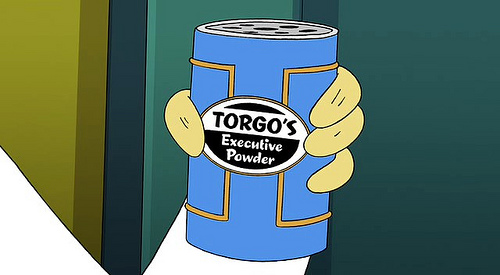
In the first Futurama comeback movie, “Bender’s Big Score,” one of the best jokes is the recurring gag, “Torgo’s Executive Powder.” A thinly veiled jab at Fox for its perceived mismanagement of Futurama, Torgo’s is made of ground-up executives, and is said to have “a million and one uses.” That may be a million and one more than non-ground-up executives.

What is an executive anyway? We hear the term thrown around a lot, but all too often executive, producer and many other titles are used interchangeably. Let’s agree on this: an executive is a management member of a company assigned to watch over a certain sector of said company. The lower executives answer to the chief executive officer (CEO).

Now let’s not get bogged down with stereotypes and ignorance. There are probably many executives who are very well-suited to the work they do. There are probably many who do genuinely good work and reap positive results for both their superiors and their staff. But we never hear about those executives. Beyond a company newsletter, you’ll never see the headline, “Executive does great work.” What you will see are headlines about how executives, through their effect on creative talents, cause difficulties in the entertainment industry. And that is our focus today: executives in the entertainment and creative industries.

The biggest problem is executives care mostly, and almost exclusively, about the bottom line; they care about how much money is being made. Being creative and artistic does not necessarily improve that bottom line. In turn, focusing on the bottom line does not necessarily result in interesting or exciting art. An executive’s directive to alter creative work to make it more profitable can have disastrous effects.


NBC, The Tonight Show and the greatest comedy duo of all time, Zucker and Ebersol


Ostensibly, NBC’s current problems are a result of low ratings for both Conan O’Brien’s The Tonight Show and Jay Leno’s prime time show – particularly Leno’s, which was hurting the lead-ins for local news shows. The executive solution: move Leno back to late night and move O’Brien back to late, late night. What the executives didn’t foresee, or didn’t care about, was that O’Brien would see this move as cutting the legs off The Tonight Show franchise, and he would not stand for it (so to speak). NBC and O’Brien have reached a settlement and Leno is expected to return to The Tonight Show after the Olympics.

Dick Ebersol, NBC executive since time immemorial and currently in charge of sports, has been very vocal about O’Brien’s poor ratings, describing him as an “astounding failure.” Ebersol further declared that he had personally offered to help O’Brien increase his ratings, but was rebuked .

Can O’Brien really be blamed for not taking advice from Dick Ebersol?

Ebersol was one of the original creators of Saturday Night Live. After Lorne Michaels left in 1980, the program entered into what some fans refer to as the “Dark Ages of SNL.” Ebersol soon took over the show and attempted to salvage it. After consistently low ratings and clashes with writers and cast members over the tone Ebersol wanted for the show, as well as accusations that he did not understand comedy (particularly the type of comedy that SNL produced), Michaels was brought back to save the franchise.

Ebersol has also been heavily criticized for his approach to Olympic Games coverage, and he presided over a period where NBC lost the rights to broadcast the NFL, MLB and NBA, among others. And, to top off that, he was also one of the driving forces behind the disastrous XFL, which produced record low ratings.

Considering his history, in what way is Dick Ebersol an expert on comedy or high ratings?

Ebersol’s comments did serve to take some of the heat off NBC CEO and President Jeff Zucker. This is the same Zucker who went to Harvard at the same time as O’Brien and was the butt of numerous O’Brien-led Harvard Lampoon pranks and the same Zucker who has the final word at NBC.

Zucker, Ebersol and the rest of NBC’s executives appear to be consciously choosing to ignore the growing pains that come with any new show. It takes time to cultivate an audience, particularly when it’s going head-to-head with a seasoned competitor such as David Letterman (and especially so when that competitor is in the midst of a sex scandal that will draw eyes to his program). Let’s not forget that Letterman also trounced Leno in the ratings until Leno was able to capitalize on Hugh Grant’s 1995 adventure in previously unexplored Ugly Hookerland.

NBC had a problem where it had two shows with ratings that were less than it desired. Its solution has resulted in the departure of Conan O’Brien, reams of bad press for the network, and the vilification of Jay Leno. Accurate or not, Leno is now seen as a greedy attention whore who could not allow someone else to take the spotlight. This does not bode well for his ratings when he returns.

(As an aside, it’s interesting to note that NBC almost O’Brien-ed Leno back in 1992. There was a time after it had made its decision to go with Leno over Letterman that the network considered changing its mind and bringing back Letterman . So if nothing else, NBC has been consistent; repugnantly so, but consistent.)


From pepperoni to piledrivers: the terrible tale of Jim Herd


Executives are all too often given too much power over subjects, on which they may have only the most tenuous grasp. That’s what happened in the terrifying tale of Jim Herd.

Herd was the manager of a St. Louis television station that aired National Wrestling Alliance shows. He then went on to serve in an executive capacity for Pizza Hut, which led to him getting a job with Turner Broadcasting. Since he had once managed a TV station that aired wrestling shows, it was decided that Jim Herd was the ideal person to run Turner’s World Championship Wrestling (WCW). If you think about it, that’s like Conrad Black becoming commissioner of the NBA because his newspapers covered basketball games.

It was a complete debacle. Herd had no understanding of the wrestling business and made decisions that led to a series of high-profile catastrophes. Most notably, he drove out the company’s best-known performer (Ric Flair), which led to WCW events plagued with chants of “We want Flair!” from the audience. Wrestling legend Dusty Rhodes would (allegedly) go on to describe Herd as, “the most untalented motherfucker in the entire world.” Rhodes had apparently never met Dick Ebersol.


The music business is a cruel and shallow money trench, a long plastic hallway where thieves and pimps run free, and good men die like dogs. There’s also a negative side.” – Hunter S. Thompson


Unfortunately, Jim Herd is far from the only executive to have been given authority over things beyond his grasp. The Pink Floyd song, “Have a Cigar,” decries this, recounting the typical, two-faced bull that spews out of record company executives. Being asked, “Which one’s Pink?” by executives who thought that Pink Floyd was the name of the band’s front man, showed that those who had so much power over the band’s future really didn’t know anything about them.

Currently, the music industry is in flux. Giant music companies still wield considerable power and are able to properly position, package and promote artists for success. However, the advent of the Internet has changed things. While some artists and labels are attempting to develop ways of doing business using the Internet — Radiohead, for example — most companies have simply dug in their heels and are attempting to shut down file-sharing websites. As with any industry, those in charge (that would be the executives) are used to a certain way of doing things, and the idea of venturing into the unknown is terrifying.


Follow the leader: Why tread your own path when you could just follow the ass of another lemming?


One of the biggest problems in every industry, but particularly in entertainment, is executive-follow-the-leader. It’s not hard to see the patterns.

In 1991, Nirvana shot to the top of the music charts, surprising record industry executives everywhere. In response, executives offered contracts to nearly every band that could play three chords and wear plaid flannel, regardless of talent, in an effort to find the next Nirvana (reports that several lumberjacks were mistaken for grunge rockers and offered contracts are unsubstantiated – but probably true).

Around that same time, television’s Seinfeld became a surprise hit and would eventually go down as one of the most popular shows of all time. However, television then became plagued with programs about clever people who sat around and said clever things. As network executives searched for the next Seinfeld, original programming became increasingly rare.

This trend continues today. The massive success of The Dark Knight has apparently inspired Warner Brothers executives in all the wrong ways:

“[Warner Brothers Pictures Group President Jeff] Robinov wants his next pack of superhero movies to be bathed in the same brooding tone as The Dark Knight. Creatively, he sees exploring the evil side to characters as the key to unlocking some of Warner Bros.’ DC properties. ‘We’re going to try to go dark to the extent that the characters allow it,’ he says. ‘That goes for the company’s Superman franchise as well.'”

It’s a very narrow mind that sees the darkness of The Dark Knight as the reason it succeeded. Batman and the characters in his world are inherently dark; that tone suited them perfectly. Superman is not a dark character. Nor is Captain Marvel, who was set for an action-comedy treatment before this new, dark (in both senses) initiative.

Making a dark Captain Marvel film is completely unnecessary and a betrayal of the character. It would be comparable to making a James Bond movie into a road-trip comedy, or making Saw VI a love story with Sandra Bullock. It’s an affront to everything the characters stand for. Warner Brothers would have a better chance of replicating The Dark Knight’s success by murdering their supporting actors to try and recreate a Heath Ledger situation than by forcing characters to be “dark.”

Of course, Warner Brothers executives haven’t necessarily always been in touch with their DC Comics properties, as Kevin Smith will tell you.


Fox Television: Where promising shows go to never really live in the first place.


The most obvious victims of Fox have been the animated shows, Futurama and Family Guy. Obviously, we can only assume that the goal of Fox Broadcasting, as a television company, is to profit from its programs. As a result, it becomes difficult to understand the reasoning behind the way that both shows were treated, particularly in light of The Simpsons’ status as Fox’s certified merchandising cash cow.

Both Futurama and Family Guy were unveiled to much fanfare, but quickly found themselves without a regular timeslot and with little advertising to promote those new slots as they came up. As a result, ratings suffered and both shows were cancelled. Clearly, these decisions did not reflect what the audience wanted, as both shows managed to resurrect themselves due to popular demand, DVD sales and high ratings for syndication.

Fox had two properties that have proven to be so popular that they have escaped the grave, which is all but unheard of in television. It’s hard to understand why the shows were never given the support they deserved given the popularity of the Simpsons franchise, which proved the power of an animated property. Of course, Fox’s problems aren’t limited to animated programs.

Television has shown that while there are runaway smash hits, sometimes a show needs time to grow (Seinfeld, for example, floundered for three seasons before becoming a monster). Fox has seen both of these phenomena first hand. While both The Simpsons and That 70’s Show were popular from the start, another long-running Fox hit, The X-Files, started as a poorly rated cult favorite before rising in the ratings and becoming a mainstream success.

The X-Files may be the only exception to a depressing and disheartening trend: Fox simply does not allow new shows time to increase their audience. Fox has cancelled a plethora of shows with great potential before they had a chance to become successful.

Another property that Fox has been accused of mismanaging is Arrested Development. Critically acclaimed, the show never gained a huge following, and was cancelled after three seasons. However, producer Mitch Hurwitz has since said, “I had taken it as far as I felt I could as a series. I told the story I wanted to tell, and we were getting to a point where I think a lot of the actors were ready to move on.”

Hurwitz’s comments raise an interesting point. It’s easy to point a finger at executives for bungling their management of a creative property. Sometimes, though, there simply isn’t a big enough audience to justify further investment. Arrested Development may be too smart for a mass audience, and the rabid fans who did love the show can re-watch them on DVDs and wait anxiously for the anticipated film version.


The office would like a word with you.…


General Electric CEO Jack Welch once said, “An overburdened, overstretched executive is the best executive, because he or she doesn’t have the time to meddle, to deal in trivia, to bother people.” And he may be right. He may be very right. Oh, hell, he is right!

The fact is we are a consumer society focused heavily on our entertainment. We tend to be very passionate about it, whether it is a band, show, film series, or anything else. Because of this, the interference of executives in the creative process is something at which we lash out. “How dare those brainless executives mess with the creative vision of (insert creative type here)?”

Certainly, there have been some — a few, maybe — good executive decisions made over the years, but there have been many more bad ones made by executives with an extremely limited knowledge of the projects for which they were responsible. They are never held accountable for the loss of culture and creativity, so we get less of both with each decision they make. They are held accountable only for the loss of revenue, which means that when they take no risks, they lose no revenue. Balls the size of peas seldom motivate anyone to take a chance on quality.

In 1209, Simon IV de Montfort, captain-general of the French forces in the Albigensian Crusade, was active at the siege of Beziers, where the entire population of 20,000 Cathars (heretics) and Catholics (the faithful) were slaughtered. Hundreds, perhaps thousands, of those unfortunates sought refuge in two cathedrals. Those in one cathedral were burned alive when it was set on fire. When Montfort’s Crusaders wondered how to tell the difference between the heretics and the faithful in the other cathedral, Cistercian abbot Arnald-Amalric responded, “Kill them all. God will recognize his own.” Those in the second cathedral were subsequently butchered, man, woman, child, and presumably pet, just in case. In the Vietnam War, Arnald-Amalric’s words were paraphrased by some anonymous soldier as, “Kill ’em all. Let God sort ’em out.”

Whether your tastes run to the 13th-century philosophy or the less elegant 20th-century variety, it seems eminently reasonable to adopt the idea where entertainment industry executives are concerned. Their few creative successes are so thoroughly outweighed by their multitude of dreck and cannibalistic re-offerings that a thorough housecleaning could have nothing but benefits. And we’d have more risks like Arrested Development and fewer safe, bottom-liners like Everybody Loves Raymond.

And that how could be bad?

(Special thanks to Augustine Funnell – http://www.gusbooks.com/)