Originally posted on Unfiltered Smoke during the height of the Conan O’Brien/Jay Leno/NBC debacle.
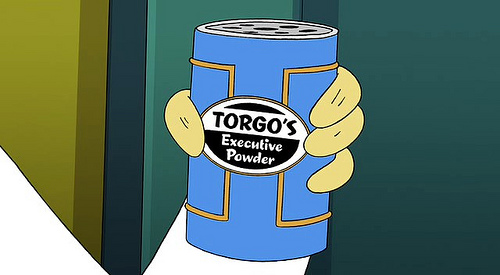
In the first Futurama comeback movie, “Bender’s Big Score,” one of the best jokes is the recurring gag, “Torgo’s Executive Powder.” A thinly veiled jab at Fox for its perceived mismanagement of Futurama, Torgo’s is made of ground-up executives, and is said to have “a million and one uses.” That may be a million and one more than non-ground-up executives.
What is an executive anyway? We hear the term thrown around a lot, but all too often executive, producer and many other titles are used interchangeably. Let’s agree on this: an executive is a management member of a company assigned to watch over a certain sector of said company. The lower executives answer to the chief executive officer (CEO).
Now let’s not get bogged down with stereotypes and ignorance. There are probably many executives who are very well-suited to the work they do. There are probably many who do genuinely good work and reap positive results for both their superiors and their staff. But we never hear about those executives. Beyond a company newsletter, you’ll never see the headline, “Executive does great work.” What you will see are headlines about how executives, through their effect on creative talents, cause difficulties in the entertainment industry. And that is our focus today: executives in the entertainment and creative industries.
The biggest problem is executives care mostly, and almost exclusively, about the bottom line; they care about how much money is being made. Being creative and artistic does not necessarily improve that bottom line. In turn, focusing on the bottom line does not necessarily result in interesting or exciting art. An executive’s directive to alter creative work to make it more profitable can have disastrous effects.
NBC, The Tonight Show and the greatest comedy duo of all time, Zucker and Ebersol
Ostensibly, NBC’s current problems are a result of low ratings for both Conan O’Brien’s The Tonight Show and Jay Leno’s prime time show – particularly Leno’s, which was hurting the lead-ins for local news shows. The executive solution: move Leno back to late night and move O’Brien back to late, late night. What the executives didn’t foresee, or didn’t care about, was that O’Brien would see this move as cutting the legs off The Tonight Show franchise, and he would not stand for it (so to speak). NBC and O’Brien have reached a settlement and Leno is expected to return to The Tonight Show after the Olympics.
Dick Ebersol, NBC executive since time immemorial and currently in charge of sports, has been very vocal about O’Brien’s poor ratings, describing him as an “astounding failure.” Ebersol further declared that he had personally offered to help O’Brien increase his ratings, but was rebuked .
Can O’Brien really be blamed for not taking advice from Dick Ebersol?
Ebersol was one of the original creators of Saturday Night Live. After Lorne Michaels left in 1980, the program entered into what some fans refer to as the “Dark Ages of SNL.” Ebersol soon took over the show and attempted to salvage it. After consistently low ratings and clashes with writers and cast members over the tone Ebersol wanted for the show, as well as accusations that he did not understand comedy (particularly the type of comedy that SNL produced), Michaels was brought back to save the franchise.
Ebersol has also been heavily criticized for his approach to Olympic Games coverage, and he presided over a period where NBC lost the rights to broadcast the NFL, MLB and NBA, among others. And, to top off that, he was also one of the driving forces behind the disastrous XFL, which produced record low ratings.
Considering his history, in what way is Dick Ebersol an expert on comedy or high ratings?
Ebersol’s comments did serve to take some of the heat off NBC CEO and President Jeff Zucker. This is the same Zucker who went to Harvard at the same time as O’Brien and was the butt of numerous O’Brien-led Harvard Lampoon pranks and the same Zucker who has the final word at NBC.
Zucker, Ebersol and the rest of NBC’s executives appear to be consciously choosing to ignore the growing pains that come with any new show. It takes time to cultivate an audience, particularly when it’s going head-to-head with a seasoned competitor such as David Letterman (and especially so when that competitor is in the midst of a sex scandal that will draw eyes to his program). Let’s not forget that Letterman also trounced Leno in the ratings until Leno was able to capitalize on Hugh Grant’s 1995 adventure in previously unexplored Ugly Hookerland.
NBC had a problem where it had two shows with ratings that were less than it desired. Its solution has resulted in the departure of Conan O’Brien, reams of bad press for the network, and the vilification of Jay Leno. Accurate or not, Leno is now seen as a greedy attention whore who could not allow someone else to take the spotlight. This does not bode well for his ratings when he returns.
(As an aside, it’s interesting to note that NBC almost O’Brien-ed Leno back in 1992. There was a time after it had made its decision to go with Leno over Letterman that the network considered changing its mind and bringing back Letterman . So if nothing else, NBC has been consistent; repugnantly so, but consistent.)
From pepperoni to piledrivers: the terrible tale of Jim Herd
Executives are all too often given too much power over subjects, on which they may have only the most tenuous grasp. That’s what happened in the terrifying tale of Jim Herd.
Herd was the manager of a St. Louis television station that aired National Wrestling Alliance shows. He then went on to serve in an executive capacity for Pizza Hut, which led to him getting a job with Turner Broadcasting. Since he had once managed a TV station that aired wrestling shows, it was decided that Jim Herd was the ideal person to run Turner’s World Championship Wrestling (WCW). If you think about it, that’s like Conrad Black becoming commissioner of the NBA because his newspapers covered basketball games.
It was a complete debacle. Herd had no understanding of the wrestling business and made decisions that led to a series of high-profile catastrophes. Most notably, he drove out the company’s best-known performer (Ric Flair), which led to WCW events plagued with chants of “We want Flair!” from the audience. Wrestling legend Dusty Rhodes would (allegedly) go on to describe Herd as, “the most untalented motherfucker in the entire world.” Rhodes had apparently never met Dick Ebersol.
“The music business is a cruel and shallow money trench, a long plastic hallway where thieves and pimps run free, and good men die like dogs. There’s also a negative side.” – Hunter S. Thompson
Unfortunately, Jim Herd is far from the only executive to have been given authority over things beyond his grasp. The Pink Floyd song, “Have a Cigar,” decries this, recounting the typical, two-faced bull that spews out of record company executives. Being asked, “Which one’s Pink?” by executives who thought that Pink Floyd was the name of the band’s front man, showed that those who had so much power over the band’s future really didn’t know anything about them.
Currently, the music industry is in flux. Giant music companies still wield considerable power and are able to properly position, package and promote artists for success. However, the advent of the Internet has changed things. While some artists and labels are attempting to develop ways of doing business using the Internet — Radiohead, for example — most companies have simply dug in their heels and are attempting to shut down file-sharing websites. As with any industry, those in charge (that would be the executives) are used to a certain way of doing things, and the idea of venturing into the unknown is terrifying.
Follow the leader: Why tread your own path when you could just follow the ass of another lemming?
One of the biggest problems in every industry, but particularly in entertainment, is executive-follow-the-leader. It’s not hard to see the patterns.
In 1991, Nirvana shot to the top of the music charts, surprising record industry executives everywhere. In response, executives offered contracts to nearly every band that could play three chords and wear plaid flannel, regardless of talent, in an effort to find the next Nirvana (reports that several lumberjacks were mistaken for grunge rockers and offered contracts are unsubstantiated – but probably true).
Around that same time, television’s Seinfeld became a surprise hit and would eventually go down as one of the most popular shows of all time. However, television then became plagued with programs about clever people who sat around and said clever things. As network executives searched for the next Seinfeld, original programming became increasingly rare.
This trend continues today. The massive success of The Dark Knight has apparently inspired Warner Brothers executives in all the wrong ways:
“[Warner Brothers Pictures Group President Jeff] Robinov wants his next pack of superhero movies to be bathed in the same brooding tone as The Dark Knight. Creatively, he sees exploring the evil side to characters as the key to unlocking some of Warner Bros.’ DC properties. ‘We’re going to try to go dark to the extent that the characters allow it,’ he says. ‘That goes for the company’s Superman franchise as well.'”
It’s a very narrow mind that sees the darkness of The Dark Knight as the reason it succeeded. Batman and the characters in his world are inherently dark; that tone suited them perfectly. Superman is not a dark character. Nor is Captain Marvel, who was set for an action-comedy treatment before this new, dark (in both senses) initiative.
Making a dark Captain Marvel film is completely unnecessary and a betrayal of the character. It would be comparable to making a James Bond movie into a road-trip comedy, or making Saw VI a love story with Sandra Bullock. It’s an affront to everything the characters stand for. Warner Brothers would have a better chance of replicating The Dark Knight’s success by murdering their supporting actors to try and recreate a Heath Ledger situation than by forcing characters to be “dark.”
Of course, Warner Brothers executives haven’t necessarily always been in touch with their DC Comics properties, as Kevin Smith will tell you.
Fox Television: Where promising shows go to never really live in the first place.
The most obvious victims of Fox have been the animated shows, Futurama and Family Guy. Obviously, we can only assume that the goal of Fox Broadcasting, as a television company, is to profit from its programs. As a result, it becomes difficult to understand the reasoning behind the way that both shows were treated, particularly in light of The Simpsons’ status as Fox’s certified merchandising cash cow.
Both Futurama and Family Guy were unveiled to much fanfare, but quickly found themselves without a regular timeslot and with little advertising to promote those new slots as they came up. As a result, ratings suffered and both shows were cancelled. Clearly, these decisions did not reflect what the audience wanted, as both shows managed to resurrect themselves due to popular demand, DVD sales and high ratings for syndication.
Fox had two properties that have proven to be so popular that they have escaped the grave, which is all but unheard of in television. It’s hard to understand why the shows were never given the support they deserved given the popularity of the Simpsons franchise, which proved the power of an animated property. Of course, Fox’s problems aren’t limited to animated programs.
Television has shown that while there are runaway smash hits, sometimes a show needs time to grow (Seinfeld, for example, floundered for three seasons before becoming a monster). Fox has seen both of these phenomena first hand. While both The Simpsons and That 70’s Show were popular from the start, another long-running Fox hit, The X-Files, started as a poorly rated cult favorite before rising in the ratings and becoming a mainstream success.
The X-Files may be the only exception to a depressing and disheartening trend: Fox simply does not allow new shows time to increase their audience. Fox has cancelled a plethora of shows with great potential before they had a chance to become successful.
Another property that Fox has been accused of mismanaging is Arrested Development. Critically acclaimed, the show never gained a huge following, and was cancelled after three seasons. However, producer Mitch Hurwitz has since said, “I had taken it as far as I felt I could as a series. I told the story I wanted to tell, and we were getting to a point where I think a lot of the actors were ready to move on.”
Hurwitz’s comments raise an interesting point. It’s easy to point a finger at executives for bungling their management of a creative property. Sometimes, though, there simply isn’t a big enough audience to justify further investment. Arrested Development may be too smart for a mass audience, and the rabid fans who did love the show can re-watch them on DVDs and wait anxiously for the anticipated film version.
The office would like a word with you.…
General Electric CEO Jack Welch once said, “An overburdened, overstretched executive is the best executive, because he or she doesn’t have the time to meddle, to deal in trivia, to bother people.” And he may be right. He may be very right. Oh, hell, he is right!
The fact is we are a consumer society focused heavily on our entertainment. We tend to be very passionate about it, whether it is a band, show, film series, or anything else. Because of this, the interference of executives in the creative process is something at which we lash out. “How dare those brainless executives mess with the creative vision of (insert creative type here)?”
Certainly, there have been some — a few, maybe — good executive decisions made over the years, but there have been many more bad ones made by executives with an extremely limited knowledge of the projects for which they were responsible. They are never held accountable for the loss of culture and creativity, so we get less of both with each decision they make. They are held accountable only for the loss of revenue, which means that when they take no risks, they lose no revenue. Balls the size of peas seldom motivate anyone to take a chance on quality.
In 1209, Simon IV de Montfort, captain-general of the French forces in the Albigensian Crusade, was active at the siege of Beziers, where the entire population of 20,000 Cathars (heretics) and Catholics (the faithful) were slaughtered. Hundreds, perhaps thousands, of those unfortunates sought refuge in two cathedrals. Those in one cathedral were burned alive when it was set on fire. When Montfort’s Crusaders wondered how to tell the difference between the heretics and the faithful in the other cathedral, Cistercian abbot Arnald-Amalric responded, “Kill them all. God will recognize his own.” Those in the second cathedral were subsequently butchered, man, woman, child, and presumably pet, just in case. In the Vietnam War, Arnald-Amalric’s words were paraphrased by some anonymous soldier as, “Kill ’em all. Let God sort ’em out.”
Whether your tastes run to the 13th-century philosophy or the less elegant 20th-century variety, it seems eminently reasonable to adopt the idea where entertainment industry executives are concerned. Their few creative successes are so thoroughly outweighed by their multitude of dreck and cannibalistic re-offerings that a thorough housecleaning could have nothing but benefits. And we’d have more risks like Arrested Development and fewer safe, bottom-liners like Everybody Loves Raymond.
And that how could be bad?
(Special thanks to Augustine Funnell – http://www.gusbooks.com/)
 mattjoneswrites